
- Current location: Home > Insights > Hard Times
Hard Times
Published:2026-07-30 05:18:00 Source: best space toys for 10 year olds Author: Contact
Hard Times
and
Reprinted Pieces [0]
By CHARLES DICKENS
With illustrations by MarcusStone,affordable toy guitars under 50 dollars Maurice
Greiffenhagen, and F. Walker
LONDON: CHAPMAN & HALL, LD.
NEW YORK: CHARLES SCRIBNER’S SONS
1905
CONTENTS
BOOK THEFIRST. SOWING | |
| PAGE |
CHAPTER I | |
The One Thing Needful | 3 |
CHAPTER II | |
Murdering the Innocents | 4 |
CHAPTER III | |
A Loophole | 8 |
CHAPTER IV | |
Mr. Bounderby | 12 |
CHAPTER V | |
The Keynote | 18 |
CHAPTER VI | |
Sleary’s Horsemanship | 23 |
CHAPTER VII | |
Mrs. Sparsit | 33 |
CHAPTER VIII | |
Never Wonder | 38 |
CHAPTER IX | |
Sissy’s Progress | 43 |
CHAPTER X | |
Stephen Blackpool | 49 |
CHAPTER XI | |
No Way Out | 53 |
CHAPTER XII | |
The Old Woman | 59 |
CHAPTER XIII | |
Rachael | 63 |
CHAPTER XIV | |
The Great Manufacturer | 69 |
CHAPTER XV | |
Father and Daughter | 73 |
CHAPTER XVI | |
Husband and Wife | 79 |
BOOK THESECOND. REAPING | |
CHAPTER I | |
Effects in the Bank | 84 |
CHAPTER II | |
Mr. James Harthouse | 94 |
CHAPTER III | |
The Whelp | 101 |
CHAPTER IV | |
Men and Brothers | 111 |
CHAPTER V | |
Men and Masters | 105 |
CHAPTER VI | |
Fading Away | 116 |
CHAPTER VII | |
Gunpowder | 126 |
CHAPTER VIII | |
Explosion | 136 |
CHAPTER IX | |
Hearing the Last of it | 146 |
CHAPTER X | |
Mrs. Sparsit’s Staircase | 152 |
CHAPTER XI | |
Lower and Lower | 156 |
CHAPTER XII | |
Down | 163 |
BOOK THETHIRD. GARNERING | |
CHAPTER I | |
Another Thing Needful | 167 |
CHAPTER II | |
Very Ridiculous | 172 |
CHAPTER III | |
Very Decided | 179 |
CHAPTER IV | |
Lost | 186 |
CHAPTER V | |
Found | 193 |
CHAPTER VI | |
The Starlight | 200 |
CHAPTER VII | |
Whelp-Hunting | 208 |
CHAPTER VIII | |
Philosophical | 216 |
CHAPTER IX | |
Final | 222 |
LIST OF ILLUSTRATIONS
| PAGE |
Stephen and Rachael in the Sick-room | 64 |
Mr. Harthouse Dining at the Bounderbys’ | 100 |
Mr. Harthouse and Tom Gradgrind in the Garden | 132 |
Stephen Blackpool recovered from the Old HellShaft | 206 |
p. 3BOOK THEFIRST
SOWING
CHAPTER I
THE ONE THING NEEDFUL
‘Now, what I want is,Facts. Teach these boys and girls nothing but Facts. Facts alone are wanted in life. Plant nothing else, androot out everything else. You can only form the minds ofreasoning animals upon Facts: nothing else will ever be of anyservice to them. This is the principle on which I bring upmy own children, and this is the principle on which I bring upthese children. Stick to Facts, sir!’
The scene was a plain, bare, monotonous vault of aschool-room, and the speaker’s square forefinger emphasizedhis observations by underscoring every sentence with a line onthe schoolmaster’s sleeve. The emphasis was helped bythe speaker’s square wall of a forehead, which had hiseyebrows for its base, while his eyes found commodious cellaragein two dark caves, overshadowed by the wall. The emphasiswas helped by the speaker’s mouth, which was wide, thin,and hard set. The emphasis was helped by thespeaker’s voice, which was inflexible, dry, anddictatorial. The emphasis was helped by the speaker’shair, which bristled on the skirts of his bald head, a plantationof firs to keep the wind from its shining surface, all coveredwith knobs, like the crust of a plum pie, as if the head hadscarcely warehouse-room for the hard facts stored inside. The speaker’s obstinate carriage, square coat, square legs,square shoulders,—nay, his very neckcloth, trained to takehim by the throat with an unaccommodating grasp, like a stubbornfact, as it was,—all helped the emphasis.
p. 4‘Inthis life, we want nothing but Facts, sir; nothing butFacts!’
The speaker, and the schoolmaster, and the third grown personpresent, all backed a little, and swept with their eyes theinclined plane of little vessels then and there arranged inorder, ready to have imperial gallons of facts poured into themuntil they were full to the brim.
CHAPTER II
MURDERING THE INNOCENTS
Thomas Gradgrind, sir. A manof realities. A man of facts and calculations. A manwho proceeds upon the principle that two and two are four, andnothing over, and who is not to be talked into allowing foranything over. Thomas Gradgrind, sir—peremptorilyThomas—Thomas Gradgrind. With a rule and a pair ofscales, and the multiplication table always in his pocket, sir,ready to weigh and measure any parcel of human nature, and tellyou exactly what it comes to. It is a mere question offigures, a case of simple arithmetic. You might hope to getsome other nonsensical belief into the head of George Gradgrind,or Augustus Gradgrind, or John Gradgrind, or Joseph Gradgrind(all supposititious, non-existent persons), but into the head ofThomas Gradgrind—no, sir!
In such terms Mr. Gradgrind always mentally introducedhimself, whether to his private circle of acquaintance, or to thepublic in general. In such terms, no doubt, substitutingthe words ‘boys and girls,’ for ‘sir,’Thomas Gradgrind now presented Thomas Gradgrind to the littlepitchers before him, who were to be filled so full of facts.
Indeed, as he eagerly sparkled at them from the cellaragebefore mentioned, he seemed a kind of cannon loaded to the muzzlewith facts, and prepared to blow them clean out of the regions ofchildhood at one discharge. He seemed a galvanizingapparatus, too, charged with a grim mechanical substitute for thetender young imaginations that were to be stormed away.
‘Girl number twenty,’ said Mr. Gradgrind, squarelypointing with his square forefinger, ‘I don’t knowthat girl. Who is that girl?’
‘Sissy Jupe, sir,’ explained number twenty,blushing, standing up, and curtseying.
‘Sissy is not a name,’ said Mr. Gradgrind. ‘Don’t call yourself Sissy. Call yourselfCecilia.’
‘It’s father as calls me Sissy, sir,’returned the young girl in a trembling voice, and with anothercurtsey.
‘Then he has no business to do it,’ said Mr.Gradgrind. ‘Tell him he mustn’t. CeciliaJupe. Let me see. What is your father?’
‘He belongs to the horse-riding, if you please,sir.’
Mr. Gradgrind frowned, and waved off the objectionable callingwith his hand.
‘We don’t want to know anything about that,here. You mustn’t tell us about that, here. Your father breaks horses, don’t he?’
‘If you please, sir, when they can get any to break,they do break horses in the ring, sir.’
‘You mustn’t tell us about the ring, here. Very well, then. Describe your father as ahorsebreaker. He doctors sick horses, I daresay?’
‘Oh yes, sir.’
‘Very well, then. He is a veterinary surgeon, afarrier, and horsebreaker. Give me your definition of ahorse.’
(Sissy Jupe thrown into the greatest alarm by thisdemand.)
‘Girl number twenty unable to define a horse!’said Mr. Gradgrind, for the general behoof of all the littlepitchers. ‘Girl number twenty possessed of no facts,in reference to one of the commonest of animals! Someboy’s definition of a horse. Bitzer,yours.’
The square finger, moving here and there, lighted suddenly onBitzer, perhaps because he chanced to sit in the same ray ofsunlight which, darting in at one of the bare windows of theintensely white-washed room, irradiated Sissy. For, theboys and girls sat on the face of the inclined plane in twocompact bodies, divided up the centre by a narrow interval; andSissy, being at the corner of a row on the sunny side, came infor the beginning of a sunbeam, of which Bitzer, being at thecorner of a row on the other side, a few rows in advance, caughtthe end. But, whereas the girl was so dark-eyed anddark-haired, that she seemed to receive a deeper and morelustrous colour from the sun, when it shone upon her, the boy wasso light-eyed and light-haired that the self-same rays appearedto draw out of him what little colour he ever possessed. His cold eyes would hardly have been eyes, but for the short endsof lashes which, by bringing them into immediate contrast withsomething paler than themselves, expressed their form. Hisshort-cropped hair might have been a mere continuation of thesandy freckles on his forehead and face. His skin was sounwholesomely deficient in the natural tinge, that he looked asthough, if he were cut, he would bleed white.
‘Bitzer,’ said Thomas Gradgrind. ‘Yourdefinition of a horse.’
‘Quadruped. Graminivorous. Forty teeth,namely twenty-four grinders, four eye-teeth, and twelveincisive. Sheds coat in the spring; in marshy countries,sheds hoofs, too. Hoofs hard, but requiring to be shod withiron. Age known by marks in mouth.’ Thus (andmuch more) Bitzer.
‘Now girl number twenty,’ said Mr.Gradgrind. ‘You know what a horse is.’
She curtseyed again, and would have blushed deeper, if shecould have blushed deeper than she had blushed all thistime. Bitzer, after rapidly blinking at Thomas Gradgrindwith both eyes at once, and so catching the light upon hisquivering ends of lashes that they looked like the antennæof busy insects, put his knuckles to his freckled forehead, andsat down again.
The third gentleman now stepped forth. A mighty man atcutting and drying, he was; a government officer; in his way (andin most other people’s too), a professed pugilist; alwaysin training, always with a system to force down the generalthroat like a bolus, always to be heard of at the bar of hislittle Public-office, ready to fight all England. Tocontinue in fistic phraseology, he had a genius for coming up tothe scratch, wherever and whatever it was, and proving himself anugly customer. He would go in and damage any subjectwhatever with his right, follow up with his left, stop, exchange,counter, bore his opponent (he always fought All England) to theropes, and fall upon him neatly. He was certain to knockthe wind out of common sense, and render that unlucky adversarydeaf to the call of time. And he had it in charge from highauthority to bring about the great public-office Millennium, whenCommissioners should reign upon earth.
‘Very well,’ said this gentleman, briskly smiling,and folding his arms. ‘That’s a horse. Now, let me ask you girls and boys, Would you paper a room withrepresentations of horses?’
After a pause, one half of the children cried in chorus,‘Yes, sir!’ Upon which the other half, seeingin the gentleman’s face that Yes was wrong, cried out inchorus, ‘No, sir!’—as the custom is, in theseexaminations.
‘Of course, No. Why wouldn’t you?’
A pause. One corpulent slow boy, with a wheezy manner ofbreathing, ventured the answer, Because he wouldn’t paper aroom at all, but would paint it.
‘You mustpaper it,’ said the gentleman,rather warmly.
‘You must paper it,’ said Thomas Gradgrind,‘whether you like it or not. Don’t tellusyou wouldn’t paper it. What do you mean,boy?’
‘I’ll explain to you, then,’ said thegentleman, after another and a dismal pause, ‘why youwouldn’t paper a room with representations of horses. Do you ever see horses walking up and down the sides of rooms inreality—in fact? Do you?’
‘Yes, sir!’ from one half. ‘No,sir!’ from the other.
‘Of course no,’ said the gentleman, with anindignant look at the wrong half. ‘Why, then, you arenot to see anywhere, what you don’t see in fact; you arenot to have anywhere, what you don’t have in fact. What is called Taste, is only another name for Fact.’ Thomas Gradgrind nodded his approbation.
‘This is a new principle, a discovery, a greatdiscovery,’ said the gentleman. ‘Now,I’ll try you again. Suppose you were going to carpeta room. Would you use a carpet having a representation offlowers upon it?’
There being a general conviction by this time that ‘No,sir!’ was always the right answer to this gentleman, thechorus of No was very strong. Only a few feeble stragglers said Yes: among them Sissy Jupe.
‘Girl number twenty,’ said the gentleman, smilingin the calm strength of knowledge.
Sissy blushed, and stood up.
‘So you would carpet your room—or yourhusband’s room, if you were a grown woman, and had ahusband—with representations of flowers, would you?’said the gentleman. ‘Why would you?’
‘If you please, sir, I am very fond of flowers,’returned the girl.
‘And is that why you would put tables and chairs uponthem, and have people walking over them with heavyboots?’
‘It wouldn’t hurt them, sir. Theywouldn’t crush and wither, if you please, sir. Theywould be the pictures of what was very pretty and pleasant, and Iwould fancy—’
‘Ay, ay, ay! But you mustn’t fancy,’cried the gentleman, quite elated by coming so happily to hispoint. ‘That’s it! You are never tofancy.’
‘You are not, Cecilia Jupe,’ Thomas Gradgrindsolemnly repeated, ‘to do anything of that kind.’
‘Fact, fact, fact!’ said the gentleman. And‘Fact, fact, fact!’ repeated Thomas Gradgrind.
‘You are to be in all things regulated andgoverned,’ said the gentleman, ‘by fact. Wehope to have, before long, a board of fact, composed ofcommissioners of fact, who will force the people to be a peopleof fact, and of nothing but fact. You must discard the wordFancy altogether. You have nothing to do with it. Youare not to have, in any object of use or ornament, what would bea contradiction in fact. You don’t walk upon flowersin fact; you cannot be allowed to walk upon flowers incarpets. You don’t find that foreign birds andbutterflies come and perch upon your crockery; you cannot bepermitted to paint foreign birds and butterflies upon yourcrockery. You never meet with quadrupeds going up and downwalls; you must not have quadrupeds represented upon walls. You must use,’ said the gentleman, ‘for all thesepurposes, combinations and modifications (in primary colours) ofmathematical figures which are susceptible of proof anddemonstration. This is the new discovery. This isfact. This is taste.’
The girl curtseyed, and sat down. She was very young,and she p.8looked as if she were frightened by the matter-of-factprospect the world afforded.
‘Now, if Mr. M’Choakumchild,’ said thegentleman, ‘will proceed to give his first lesson here, Mr.Gradgrind, I shall be happy, at your request, to observe his modeof procedure.’
Mr. Gradgrind was much obliged. ‘Mr.M’Choakumchild, we only wait for you.’
So, Mr. M’Choakumchild began in his best manner. He and some one hundred and forty other schoolmasters, had beenlately turned at the same time, in the same factory, on the sameprinciples, like so many pianoforte legs. He had been putthrough an immense variety of paces, and had answered volumes ofhead-breaking questions. Orthography, etymology, syntax,and prosody, biography, astronomy, geography, and generalcosmography, the sciences of compound proportion, algebra,land-surveying and levelling, vocal music, and drawing frommodels, were all at the ends of his ten chilled fingers. Hehad worked his stony way into Her Majesty’s most HonourablePrivy Council’s Schedule B, and had taken the bloom off thehigher branches of mathematics and physical science, French,German, Latin, and Greek. He knew all about all the WaterSheds of all the world (whatever they are), and all the historiesof all the peoples, and all the names of all the rivers andmountains, and all the productions, manners, and customs of allthe countries, and all their boundaries and bearings on the twoand thirty points of the compass. Ah, rather overdone,M’Choakumchild. If he had only learnt a little less,how infinitely better he might have taught much more!
He went to work in this preparatory lesson, not unlikeMorgiana in the Forty Thieves: looking into all the vesselsranged before him, one after another, to see what theycontained. Say, good M’Choakumchild. When fromthy boiling store, thou shalt fill each jar brim full by-and-by,dost thou think that thou wilt always kill outright the robberFancy lurking within—or sometimes only maim him and distorthim!
CHAPTER III
A LOOPHOLE
Mr. Gradgrind walked homeward fromthe school, in a state of considerable satisfaction. It washis school, and he intended it to be a model. He intendedevery child in it to be a model—just as the youngGradgrinds were all models.
There were five young Gradgrinds, and they were models everyone. They had been lectured at, from their tenderest years;coursed, like little hares. Almost as soon as they couldrun alone, they had been made to run to the lecture-room. The first object with which they had an association, or of whichthey had a remembrance, was a large black board with a dry Ogrechalking ghastly white figures on it.
Not that they knew, by name or nature, anything about an OgreFact forbid! I only use the word to express a monster in alecturing castle, with Heaven knows how many heads manipulatedinto one, taking childhood captive, and dragging it into gloomystatistical dens by the hair.
No little Gradgrind had ever seen a face in the moon; it wasup in the moon before it could speak distinctly. No littleGradgrind had ever learnt the silly jingle, Twinkle, twinkle,little star; how I wonder what you are! No little Gradgrindhad ever known wonder on the subject, each little Gradgrindhaving at five years old dissected the Great Bear like aProfessor Owen, and driven Charles’s Wain like a locomotiveengine-driver. No little Gradgrind had ever associated acow in a field with that famous cow with the crumpled horn whotossed the dog who worried the cat who killed the rat who ate themalt, or with that yet more famous cow who swallowed Tom Thumb:it had never heard of those celebrities, and had only beenintroduced to a cow as a graminivorous ruminating quadruped withseveral stomachs.
To his matter-of-fact home, which was called Stone Lodge, Mr.Gradgrind directed his steps. He had virtually retired fromthe wholesale hardware trade before he built Stone Lodge, and wasnow looking about for a suitable opportunity of making anarithmetical figure in Parliament. Stone Lodge was situatedon a moor within a mile or two of a great town—calledCoketown in the present faithful guide-book.
A very regular feature on the face of the country, Stone Lodgewas. Not the least disguise toned down or shaded off thatuncompromising fact in the landscape. A great square house,with a heavy portico darkening the principal windows, as itsmaster’s heavy brows overshadowed his eyes. Acalculated, cast up, balanced, and proved house. Sixwindows on this side of the door, six on that side; a total oftwelve in this wing, a total of twelve in the other wing;four-and-twenty carried over to the back wings. A lawn andgarden and an infant avenue, all ruled straight like a botanicalaccount-book. Gas and ventilation, drainage andwater-service, all of the primest quality. Iron clamps andgirders, fire-proof from top to bottom; mechanical lifts for thehousemaids, with all their brushes and brooms; everything thatheart could desire.
Everything? Well, I suppose so. The littleGradgrinds had cabinets in various departments of sciencetoo. They had a little conchological cabinet, and a littlemetallurgical cabinet, and a little mineralogical cabinet; andthe specimens were all arranged and labelled, and the bits ofstone and ore looked as though they might have been broken fromthe parent substances by those tremendously hard instrumentstheir own names; and, to paraphrase the idle legend of PeterPiper, who had never found his way into their nursery, If thegreedy little Gradgrinds grasped at more than this, what was itfor good gracious goodness’ sake, that the greedy littleGradgrinds grasped it!
Their father walked on in a hopeful and satisfied frame ofmind. He was an affectionate father, after his manner; buthe would probably have described himself (if he had been put,like Sissy Jupe, upon a definition) as ‘an eminentlypractical’ father. He had a particular pride in thephrase eminently practical, which was considered to have aspecial application to him. Whatsoever the public meetingheld in Coketown, and whatsoever the subject of such meeting,some Coketowner was sure to seize the occasion of alluding to hiseminently practical friend Gradgrind. This always pleasedthe eminently practical friend. He knew it to be his due,but his due was acceptable.
He had reached the neutral ground upon the outskirts of thetown, which was neither town nor country, and yet was eitherspoiled, when his ears were invaded by the sound of music. The clashing and banging band attached to the horse-ridingestablishment, which had there set up its rest in a woodenpavilion, was in full bray. A flag, floating from thesummit of the temple, proclaimed to mankind that it was‘Sleary’s Horse-riding’ which claimed theirsuffrages. Sleary himself, a stout modern statue with amoney-box at its elbow, in an ecclesiastical niche of earlyGothic architecture, took the money. Miss Josephine Sleary,as some very long and very narrow strips of printed billannounced, was then inaugurating the entertainments with hergraceful equestrian Tyrolean flower-act. Among the otherpleasing but always strictly moral wonders which must be seen tobe believed, Signor Jupe was that afternoon to ‘elucidatethe diverting accomplishments of his highly trained performingdog Merrylegs.’ He was also to exhibit ‘hisastounding feat of throwing seventy-five hundred-weight in rapidsuccession backhanded over his head, thus forming a fountain ofsolid iron in mid-air, a feat never before attempted in this orany other country, and which having elicited such rapturousplaudits from enthusiastic throngs it cannot bewithdrawn.’ The same Signor Jupe was to‘enliven the varied performances at frequent intervals withhis chaste Shaksperean quips and retorts.’ Lastly, hewas to wind them up by appearing in his favourite character ofMr. William Button, of Tooley Street, in ‘the highly noveland laughable hippo-comedietta of The Tailor’s Journey toBrentford.’
Thomas Gradgrind took no heed of these trivialities of course,but passed on as a practical man ought to pass on, eitherbrushing the noisy insects from his thoughts, or consigning themto the House of Correction. But, the turning of the roadtook him by the back of the booth, and at the back of the booth anumber of children were congregated in a number of stealthyattitudes, striving to peep in at the hidden glories of theplace.
This brought him to a stop. ‘Now, to think ofthese vagabonds,’ said he, ‘attracting the youngrabble from a model school.’
A space of stunted grass and dry rubbish being between him andthe young rabble, he took his eyeglass out of his waistcoat tolook for any child he knew by name, and might order off. Phenomenon almost incredible though distinctly seen, what did hethen behold but his own metallurgical Louisa, peeping with allher might through a hole in a deal board, and his ownmathematical Thomas abasing himself on the ground to catch but ahoof of the graceful equestrian Tyrolean flower-act!
Dumb with amazement, Mr. Gradgrind crossed to the spot wherehis family was thus disgraced, laid his hand upon each erringchild, and said:
‘Louisa!! Thomas!!’
Both rose, red and disconcerted. But, Louisa looked ather father with more boldness than Thomas did. Indeed,Thomas did not look at him, but gave himself up to be taken homelike a machine.
‘In the name of wonder, idleness, and folly!’ saidMr. Gradgrind, leading each away by a hand; ‘what do you dohere?’
‘Wanted to see what it was like,’ returned Louisa,shortly.
‘What it was like?’
‘Yes, father.’
There was an air of jaded sullenness in them both, andparticularly in the girl: yet, struggling through thedissatisfaction of her face, there was a light with nothing torest upon, a fire with nothing to burn, a starved imaginationkeeping life in itself somehow, which brightened itsexpression. Not with the brightness natural to cheerfulyouth, but with uncertain, eager, doubtful flashes, which hadsomething painful in them, analogous to the changes on a blindface groping its way.
She was a child now, of fifteen or sixteen; but at no distantday would seem to become a woman all at once. Her fatherthought so as he looked at her. She was pretty. Wouldhave been self-willed (he thought in his eminently practical way)but for her bringing-up.
‘Thomas, though I have the fact before me, I find itdifficult to believe that you, with your education and resources,should have brought your sister to a scene like this.’
p.12‘I brought him, father,’ said Louisa,quickly. ‘I asked him to come.’
‘I am sorry to hear it. I am very sorry indeed tohear it. It makes Thomas no better, and it makes you worse,Louisa.’
She looked at her father again, but no tear fell down hercheek.
‘You! Thomas and you, to whom the circle of thesciences is open; Thomas and you, who may be said to be repletewith facts; Thomas and you, who have been trained to mathematicalexactness; Thomas and you, here!’ cried Mr.Gradgrind. ‘In this degraded position! I amamazed.’
‘I was tired, father. I have been tired a longtime,’ said Louisa.
‘Tired? Of what?’ asked the astonishedfather.
‘I don’t know of what—of everything, Ithink.’
‘Say not another word,’ returned Mr.Gradgrind. ‘You are childish. I will hear nomore.’ He did not speak again until they had walkedsome half-a-mile in silence, when he gravely broke out with:‘What would your best friends say, Louisa? Do youattach no value to their good opinion? What would Mr.Bounderby say?’ At the mention of this name, hisdaughter stole a look at him, remarkable for its intense andsearching character. He saw nothing of it, for before helooked at her, she had again cast down her eyes!
‘What,’ he repeated presently, ‘would Mr.Bounderby say?’ All the way to Stone Lodge, as withgrave indignation he led the two delinquents home, he repeated atintervals ‘What would Mr. Bounderby say?’—as ifMr. Bounderby had been Mrs. Grundy.
CHAPTER IV
MR. BOUNDERBY
Not being Mrs. Grundy, whowasMr. Bounderby?
Why, Mr. Bounderby was as near being Mr. Gradgrind’sbosom friend, as a man perfectly devoid of sentiment can approachthat spiritual relationship towards another man perfectly devoidof sentiment. So near was Mr. Bounderby—or, if thereader should prefer it, so far off.
He was a rich man: banker, merchant, manufacturer, and whatnot. A big, loud man, with a stare, and a metalliclaugh. A man made out of a coarse material, which seemed tohave been stretched to make so much of him. A man with agreat puffed head and forehead, swelled veins in his temples, andsuch a strained skin to his face that it seemed to hold his eyesopen, and lift his eyebrows up. A man with a pervadingappearance on him of being inflated like a balloon, and ready tostart. A man who could never sufficiently vaunt himself aself-made man. A man who was always proclaiming, throughthat brassy speaking-trumpet of a voice of his, his old ignoranceand his old poverty. A man who was the Bully ofhumility.
A year or two younger than his eminently practical friend, Mr.Bounderby looked older; his seven or eight and forty might havehad the seven or eight added to it again, without surprisinganybody. He had not much hair. One might have fanciedhe had talked it off; and that what was left, all standing up indisorder, was in that condition from being constantly blown aboutby his windy boastfulness.
In the formal drawing-room of Stone Lodge, standing on thehearthrug, warming himself before the fire, Mr. Bounderbydelivered some observations to Mrs. Gradgrind on the circumstanceof its being his birthday. He stood before the fire, partlybecause it was a cool spring afternoon, though the sun shone;partly because the shade of Stone Lodge was always haunted by theghost of damp mortar; partly because he thus took up a commandingposition, from which to subdue Mrs. Gradgrind.
‘I hadn’t a shoe to my foot. As to astocking, I didn’t know such a thing by name. Ipassed the day in a ditch, and the night in a pigsty. That’s the way I spent my tenth birthday. Not that aditch was new to me, for I was born in a ditch.’
Mrs. Gradgrind, a little, thin, white, pink-eyed bundle ofshawls, of surpassing feebleness, mental and bodily; who wasalways taking physic without any effect, and who, whenever sheshowed a symptom of coming to life, was invariably stunned bysome weighty piece of fact tumbling on her; Mrs. Gradgrind hopedit was a dry ditch?
‘No! As wet as a sop. A foot of water init,’ said Mr. Bounderby.
‘Enough to give a baby cold,’ Mrs. Gradgrindconsidered.
‘Cold? I was born with inflammation of the lungs,and of everything else, I believe, that was capable ofinflammation,’ returned Mr. Bounderby. ‘Foryears, ma’am, I was one of the most miserable littlewretches ever seen. I was so sickly, that I was alwaysmoaning and groaning. I was so ragged and dirty, that youwouldn’t have touched me with a pair of tongs.’
Mrs. Gradgrind faintly looked at the tongs, as the mostappropriate thing her imbecility could think of doing.
‘How I fought through it, Idon’tknow,’ said Bounderby. ‘I was determined, Isuppose. I have been a determined character in later life,and I suppose I was then. Here I am, Mrs. Gradgrind,anyhow, and nobody to thank for my being here, butmyself.’
Mrs. Gradgrind meekly and weakly hoped that hismother—
‘Mymother? Bolted, ma’am!’said Bounderby.
Mrs. Gradgrind, stunned as usual, collapsed and gave itup.
‘My mother left me to my grandmother,’ saidBounderby; ‘and, according to the best of my remembrance,my grandmother was the wickedest and the worst old woman thatever lived. If I got a little pair of shoes by any chance,she would take ’em off and sell ’em for drink. Why, I have known that grandmother of mine lie in her bed anddrink her four-teen glasses of liquor beforebreakfast!’
Mrs. Gradgrind, weakly smiling, and giving no other sign ofvitality, looked (as she always did) like an indifferentlyexecuted transparency of a small female figure, without enoughlight behind it.
‘She kept a chandler’s shop,’ pursuedBounderby, ‘and kept me in an egg-box. That was thecot of myinfancy; an old egg-box. As soon as I wasbig enough to run away, of course I ran away. Then I becamea young vagabond; and instead of one old woman knocking me aboutand starving me, everybody of all ages knocked me about andstarved me. They were right; they had no business to doanything else. I was a nuisance, an incumbrance, and apest. I know that very well.’
His pride in having at any time of his life achieved such agreat social distinction as to be a nuisance, an incumbrance, anda pest, was only to be satisfied by three sonorous repetitions ofthe boast.
‘I was to pull through it, I suppose, Mrs.Gradgrind. Whether I was to do it or not, ma’am, Idid it. I pulled through it, though nobody threw me out arope. Vagabond, errand-boy, vagabond, labourer, porter,clerk, chief manager, small partner, Josiah Bounderby ofCoketown. Those are the antecedents, and theculmination. Josiah Bounderby of Coketown learnt hisletters from the outsides of the shops, Mrs. Gradgrind, and wasfirst able to tell the time upon a dial-plate, from studying thesteeple clock of St. Giles’s Church, London, under thedirection of a drunken cripple, who was a convicted thief, and anincorrigible vagrant. Tell Josiah Bounderby of Coketown, ofyour district schools and your model schools, and your trainingschools, and your whole kettle-of-fish of schools; and JosiahBounderby of Coketown, tells you plainly, all right, allcorrect—he hadn’t such advantages—but let ushave hard-headed, solid-fisted people—the education thatmade him won’t do for everybody, he knows well—suchand such his education was, however, and you may force him toswallow boiling fat, but you shall never force him to suppressthe facts of his life.’
Being heated when he arrived at this climax, Josiah Bounderbyof Coketown stopped. He stopped just as his eminentlypractical friend, still accompanied by the two young culprits,entered the room. His eminently practical friend, on seeinghim, stopped also, and gave Louisa a reproachful look thatplainly said, ‘Behold your Bounderby!’
‘Well!’ blustered Mr. Bounderby,‘what’s the matter? What is young Thomas in thedumps about?’
He spoke of young Thomas, but he looked at Louisa.
‘We were peeping at the circus,’ muttered Louisa,haughtily, without lifting up her eyes, ‘and father caughtus.’
‘And, Mrs. Gradgrind,’ said her husband in a loftymanner, ‘I should as soon have expected to find my childrenreading poetry.’
‘Dear me,’ whimpered Mrs. Gradgrind. ‘How can you, Louisa and Thomas! I wonder atyou. I declare you’re enough to make one regret everhaving had a family at all. I have a great mind to say Iwish I hadn’t. Thenwhat would you have done,I should like to know?’
Mr. Gradgrind did not seem favourably impressed by thesecogent remarks. He frowned impatiently.
‘As if, with my head in its present throbbing state, youcouldn’t go and look at the shells and minerals and thingsprovided for you, instead of circuses!’ said Mrs.Gradgrind. ‘You know, as well as I do, no youngpeople have circus masters, or keep circuses in cabinets, orattend lectures about circuses. What can you possibly wantto know of circuses then? I am sure you have enough to do,if that’s what you want. With my head in its presentstate, I couldn’t remember the mere names of half the factsyou have got to attend to.’
‘That’s the reason!’ pouted Louisa.
‘Don’t tell me that’s the reason, because itcan’t be nothing of the sort,’ said Mrs.Gradgrind. ‘Go and be somethingologicaldirectly.’ Mrs. Gradgrind was not a scientificcharacter, and usually dismissed her children to their studieswith this general injunction to choose their pursuit.
In truth, Mrs. Gradgrind’s stock of facts in general waswoefully defective; but Mr. Gradgrind in raising her to her highmatrimonial position, had been influenced by two reasons. Firstly, she was most satisfactory as a question of figures; and,secondly, she had ‘no nonsense’ about her. Bynonsense he meant fancy; and truly it is probable she was as freefrom any alloy of that nature, as any human being not arrived atthe perfection of an absolute idiot, ever was.
The simple circumstance of being left alone with her husbandand Mr. Bounderby, was sufficient to stun this admirable ladyagain without collision between herself and any other fact. So, she once more died away, and nobody minded her.
‘Bounderby,’ said Mr. Gradgrind, drawing a chairto the fireside, ‘you are always so interested in my youngpeople—particularly in Louisa—that I make no apologyfor saying to you, I am very much vexed by this discovery. I have systematically devoted myself (as you know) to theeducation of the reason of my family. The reason is (as youknow) the only faculty to which education should beaddressed. ‘And yet, Bounderby, it would appear fromthis unexpected circumstance of to-day, though in itself atrifling one, as if something had crept into Thomas’s andLouisa’s minds which is—or rather, which isnot—I don’t know that I can express myself betterthan by saying—which has never been intended to bedeveloped, and in which their reason has no part.’
‘There certainly is no reason in looking with interestat a parcel of vagabonds,’ returned Bounderby. ‘When I was a vagabond myself, nobody looked with anyinterest at me; I know that.’
‘Then comes the question; said the eminently practicalfather, with his eyes on the fire, ‘in what has this vulgarcuriosity its rise?’
‘I’ll tell you in what. In idleimagination.’
‘I hope not,’ said the eminently practical;‘I confess, however, that the misgiving hascrossedme on my way home.’
‘In idle imagination, Gradgrind,’ repeatedBounderby. ‘A very bad thing for anybody, but acursed bad thing for a girl like Louisa. I should ask Mrs.Gradgrind’s pardon for strong expressions, but that sheknows very well I am not a refined character. Whoeverexpects refinement in mewill be disappointed. Ihadn’t a refined bringing up.’
‘Whether,’ said Gradgrind, pondering with hishands in his pockets, and his cavernous eyes on the fire,‘whether any instructor or servant can have suggestedanything? Whether Louisa or Thomas can have been readinganything? Whether, in spite of all precautions, any idlestory-book can have got into the house? Because, in mindsthat have been practically formed by rule and line, from thecradle upwards, this is so curious, soincomprehensible.’
‘Stop a bit!’ cried Bounderby, who all this timehad been standing, as before, on the hearth, bursting at the veryfurniture of the room with explosive humility. ‘Youhave one of those strollers’ children in theschool.’
‘Cecilia Jupe, by name,’ said Mr. Gradgrind, withsomething of a stricken look at his friend.
‘Now, stop a bit!’ cried Bounderby again. ‘How did she come there?’
‘Why, the fact is, I saw the girl myself, for the firsttime, only just now. She specially applied here at thehouse to be admitted, as not regularly belonging to our town,and—yes, you are right, Bounderby, you areright.’
‘Now, stop a bit!’ cried Bounderby, oncemore. ‘Louisa saw her when she came?’
‘Louisa certainly did see her, for she mentioned theapplication to me. But Louisa saw her, I have no doubt, inMrs. Gradgrind’s presence.’
‘Pray, Mrs. Gradgrind,’ said Bounderby,‘what passed?’
‘Oh, my poor health!’ returned Mrs.Gradgrind. ‘The girl wanted to come to the school,and Mr. Gradgrind wanted girls to come to the school, and Louisaand Thomas both said that the girl wanted to come, and that Mr.Gradgrind wanted girls to come, and how was it possible tocontradict them when such was the fact!’
‘Now I tell you what, Gradgrind!’ said Mr.Bounderby. ‘Turn this girl to the right about, andthere’s an end of it.’
‘I am much of your opinion.’
‘Do it at once,’ said Bounderby, ‘has alwaysbeen my motto from a child. When I thought I would run awayfrom my egg-box and my grandmother, I did it at once. Doyou the same. Do this at once!’
‘Are you walking?’ asked his friend. ‘I have the father’s address. Perhaps you wouldnot mind walking to town with me?’
‘Not the least in the world,’ said Mr. Bounderby,‘as long as you do it at once!’
So, Mr. Bounderby threw on his hat—he always threw iton, as expressing a man who had been far too busily employed inmaking himself, to acquire any fashion of wearing hishat—and with his hands in his pockets, sauntered out intothe hall. ‘I never wear gloves,’ it was hiscustom to say. ‘I didn’t climb up the ladder inthem.—Shouldn’t be so high up, if Ihad.’
Being left to saunter in the hall a minute or two while Mr.Gradgrind went up-stairs for the address, he opened the door ofthe children’s study and looked into that serenefloor-clothed apartment, which, notwithstanding its book-casesand its cabinets and its variety of learned and philosophicalappliances, had much of the genial aspect of a room devoted tohair-cutting. Louisa languidly leaned upon the windowlooking out, without looking at anything, while young Thomasstood sniffing revengefully at the fire. Adam Smith andMalthus, two younger Gradgrinds, were out at lecture in custody;and little Jane, after manufacturing a good deal of moistpipe-clay on her face with slate-pencil and tears, had fallenasleep over vulgar fractions.
‘It’s all right now, Louisa: it’s all right,young Thomas,’ said Mr. Bounderby; ‘you won’tdo so any more. I’ll answer for it’s being allover with father. Well, Louisa, that’s worth a kiss,isn’t it?’
‘You can take one, Mr. Bounderby,’ returnedLouisa, when she had coldly paused, and slowly walked across theroom, and p.18ungraciously raised her cheek towards him, with her faceturned away.
‘Always my pet; ain’t you, Louisa?’ said Mr.Bounderby. ‘Good-bye, Louisa!’
He went his way, but she stood on the same spot, rubbing thecheek he had kissed, with her handkerchief, until it was burningred. She was still doing this, five minutes afterwards.
‘What are you about, Loo?’ her brother sulkilyremonstrated. ‘You’ll rub a hole in yourface.’
‘You may cut the piece out with your penknife if youlike, Tom. I wouldn’t cry!’
CHAPTER V
THE KEYNOTE
Coketown, to which Messrs.Bounderby and Gradgrind now walked, was a triumph of fact; it hadno greater taint of fancy in it than Mrs. Gradgrindherself. Let us strike the key-note, Coketown, beforepursuing our tune.
It was a town of red brick, or of brick that would have beenred if the smoke and ashes had allowed it; but as matters stood,it was a town of unnatural red and black like the painted face ofa savage. It was a town of machinery and tall chimneys, outof which interminable serpents of smoke trailed themselves forever and ever, and never got uncoiled. It had a black canalin it, and a river that ran purple with ill-smelling dye, andvast piles of building full of windows where there was a rattlingand a trembling all day long, and where the piston of thesteam-engine worked monotonously up and down, like the head of anelephant in a state of melancholy madness. It containedseveral large streets all very like one another, and many smallstreets still more like one another, inhabited by people equallylike one another, who all went in and out at the same hours, withthe same sound upon the same pavements, to do the same work, andto whom every day was the same as yesterday and to-morrow, andevery year the counterpart of the last and the next.
These attributes of Coketown were in the main inseparable fromthe work by which it was sustained; against them were to be setoff, comforts of life which found their way all over the world,and elegancies of life which made, we will not ask how much ofthe fine lady, who could scarcely bear to hear the placementioned. The rest of its features were voluntary, andthey were these.
You saw nothing in Coketown but what was severelyworkful. If the members of a religious persuasion built achapel there—as the members of eighteen religiouspersuasions had done—they made it a pious warehouse of redbrick, with sometimes (but this is only in highly ornamentalexamples) a bell in a birdcage on the top of it. Thesolitary exception was the New Church; a stuccoed edifice with asquare steeple over the door, terminating in four short pinnacleslike florid wooden legs. All the public inscriptions in thetown were painted alike, in severe characters of black andwhite. The jail might have been the infirmary, theinfirmary might have been the jail, the town-hall might have beeneither, or both, or anything else, for anything that appeared tothe contrary in the graces of their construction. Fact,fact, fact, everywhere in the material aspect of the town; fact,fact, fact, everywhere in the immaterial. TheM’Choakumchild school was all fact, and the school ofdesign was all fact, and the relations between master and manwere all fact, and everything was fact between the lying-inhospital and the cemetery, and what you couldn’t state infigures, or show to be purchaseable in the cheapest market andsaleable in the dearest, was not, and never should be, worldwithout end, Amen.
A town so sacred to fact, and so triumphant in its assertion,of course got on well? Why no, not quite well. No? Dear me!
No. Coketown did not come out of its own furnaces, inall respects like gold that had stood the fire. First, theperplexing mystery of the place was, Who belonged to the eighteendenominations? Because, whoever did, the labouring peopledid not. It was very strange to walk through the streets ona Sunday morning, and note how few of themthe barbarousjangling of bells that was driving the sick and nervous mad,called away from their own quarter, from their own close rooms,from the corners of their own streets, where they loungedlistlessly, gazing at all the church and chapel going, as at athing with which they had no manner of concern. Nor was itmerely the stranger who noticed this, because there was a nativeorganization in Coketown itself, whose members were to be heardof in the House of Commons every session, indignantly petitioningfor acts of parliament that should make these people religious bymain force. Then came the Teetotal Society, who complainedthat these same people wouldget drunk, and showed intabular statements that they did get drunk, and proved at teaparties that no inducement, human or Divine (except a medal),would induce them to forego their custom of getting drunk. Then came the chemist and druggist, with other tabularstatements, showing that when they didn’t get drunk, theytook opium. Then came the experienced chaplain of the jail,with more tabular statements, outdoing all the previous tabularstatements, and showing that the same people wouldresortto low haunts, hidden from the public eye, where they heard lowsinging and saw low dancing, and mayhap joined in it; and whereA. B., aged twenty-four next birthday, and committed for eighteenmonths’ solitary, had himself said (not that he had evershown himself particularly worthy of belief) his ruin began, ashe was perfectly sure and confident that otherwise he would havebeen a tip-top moral specimen. Then came Mr. Gradgrind andMr. Bounderby, the two gentlemen at this present moment walkingthrough Coketown, and both eminently practical, who could, onoccasion, furnish more tabular statements derived from their ownpersonal experience, and illustrated by cases they had known andseen, from which it clearly appeared—in short, it was theonly clear thing in the case—that these same people were abad lot altogether, gentlemen; that do what you would for themthey were never thankful for it, gentlemen; that they wererestless, gentlemen; that they never knew what they wanted; thatthey lived upon the best, and bought fresh butter; and insistedon Mocha coffee, and rejected all but prime parts of meat, andyet were eternally dissatisfied and unmanageable. In short,it was the moral of the old nursery fable:
There was an old woman, and what do you think?
She lived upon nothing but victuals and drink;
Victuals and drink were the whole of her diet,
And yet this old woman would NEVERbe quiet.
Is it possible, I wonder, that there was any analogy betweenthe case of the Coketown population and the case of the littleGradgrinds? Surely, none of us in our sober senses andacquainted with figures, are to be told at this time of day, thatone of the foremost elements in the existence of the Coketownworking-people had been for scores of years, deliberately set atnought? That there was any Fancy in them demanding to bebrought into healthy existence instead of struggling on inconvulsions? That exactly in the ratio as they worked longand monotonously, the craving grew within them for some physicalrelief—some relaxation, encouraging good humour and goodspirits, and giving them a vent—some recognized holiday,though it were but for an honest dance to a stirring band ofmusic—some occasional light pie in which evenM’Choakumchild had no finger—which craving must andwould be satisfied aright, or must and would inevitably go wrong,until the laws of the Creation were repealed?
‘This man lives at Pod’s End, and I don’tquite know Pod’s End,’ said Mr. Gradgrind. ‘Which is it, Bounderby?’
Mr. Bounderby knew it was somewhere down town, but knew nomore respecting it. So they stopped for a moment, lookingabout.
Almost as they did so, there came running round the corner ofthe street at a quick pace and with a frightened look, a girlwhom Mr. Gradgrind recognized. ‘Halloa!’ saidhe. ‘Stop! Where are you going!Stop!’ Girl number twenty stopped then, palpitating,and made him a curtsey.
‘Why are you tearing about the streets,’ said Mr.Gradgrind, ‘in this improper manner?’
‘I was—I was run after, sir,’ the girlpanted, ‘and I wanted to get away.’
‘Run after?’ repeated Mr. Gradgrind. ‘Who would run after you?’
The question was unexpectedly and suddenly answered for her,by the colourless boy, Bitzer, who came round the corner withsuch blind speed and so little anticipating a stoppage on thepavement, that he brought himself up against Mr.Gradgrind’s waistcoat and rebounded into the road.
‘What do you mean, boy?’ said Mr. Gradgrind. ‘What are you doing? How dare you dashagainst—everybody—in this manner?’ Bitzerpicked up his cap, which the concussion had knocked off; andbacking, and knuckling his forehead, pleaded that it was anaccident.
‘Was this boy running after you, Jupe?’ asked Mr.Gradgrind.
‘Yes, sir,’ said the girl reluctantly.
‘No, I wasn’t, sir!’ cried Bitzer. ‘Not till she run away from me. But the horse-ridersnever mind what they say, sir; they’re famous for it. You know the horse-riders are famous for never minding what theysay,’ addressing Sissy. ‘It’s as wellknown in the town as—please, sir, as the multiplicationtable isn’t known to the horse-riders.’ Bitzertried Mr. Bounderby with this.
‘He frightened me so,’ said the girl, ‘withhis cruel faces!’
‘Oh!’ cried Bitzer. ‘Oh! An’t you one of the rest! An’t you ahorse-rider! I never looked at her, sir. I asked herif she would know how to define a horse to-morrow, and offered totell her again, and she ran away, and I ran after her, sir, thatshe might know how to answer when she was asked. Youwouldn’t have thought of saying such mischief if youhadn’t been a horse-rider?’
‘Her calling seems to be pretty well known among’em,’ observed Mr. Bounderby. ‘You’d have had the whole school peeping in a row, ina week.’
‘Truly, I think so,’ returned his friend. ‘Bitzer, turn you about and take yourself home. Jupe, stayhere a moment. Let me hear of your running in this mannerany more, boy, and you will hear of me through the master of theschool. You understand what I mean. Goalong.’
The boy stopped in his rapid blinking, knuckled his foreheadagain, glanced at Sissy, turned about, and retreated.
‘Now, girl,’ said Mr. Gradgrind, ‘take thisgentleman and me to your father’s; we are goingthere. What have you got in that bottle you arecarrying?’
‘Gin,’ said Mr. Bounderby.
‘Dear, no, sir! It’s the nineoils.’
‘The what?’ cried Mr. Bounderby.
‘The nine oils, sir, to rub father with.’
‘Then,’ said Mr. Bounderby, with a loud shortlaugh, ‘what the devil do you rub your father with nineoils for?’
‘It’s what our people aways use, sir, when theyget any hurts in the ring,’ replied the girl, looking overher shoulder, to assure herself that her pursuer was gone. ‘They bruise themselves very bad sometimes.’
‘Serve ’em right,’ said Mr. Bounderby,‘for being idle.’ She glanced up at his face,with mingled astonishment and dread.
‘By George!’ said Mr. Bounderby, ‘when I wasfour or five years younger than you, I had worse bruises upon methan ten oils, twenty oils, forty oils, would have rubbedoff. I didn’t get ’em by posture-making, but bybeing banged about. There was no rope-dancing for me; Idanced on the bare ground and was larruped with therope.’
Mr. Gradgrind, though hard enough, was by no means so rough aman as Mr. Bounderby. His character was not unkind, allthings considered; it might have been a very kind one indeed, ifhe had only made some round mistake in the arithmetic thatbalanced it, years ago. He said, in what he meant for areassuring tone, as they turned down a narrow road, ‘Andthis is Pod’s End; is it, Jupe?’
‘This is it, sir, and—if you wouldn’t mind,sir—this is the house.’
She stopped, at twilight, at the door of a mean littlepublic-house, with dim red lights in it. As haggard and asshabby, as if, for want of custom, it had itself taken todrinking, and had gone the way all drunkards go, and was verynear the end of it.
‘It’s only crossing the bar, sir, and up thestairs, if you wouldn’t mind, and waiting there for amoment till I get a candle. If you should hear a dog, sir,it’s only Merrylegs, and he only barks.’
‘Merrylegs and nine oils, eh!’ said Mr. Bounderby,entering last with his metallic laugh. ‘Pretty wellthis, for a self-made man!’
p.23CHAPTER VI
SLEARY’S HORSEMANSHIP
The name of the public-house wasthe Pegasus’s Arms. The Pegasus’s legs mighthave been more to the purpose; but, underneath the winged horseupon the sign-board, the Pegasus’s Arms was inscribed inRoman letters. Beneath that inscription again, in a flowingscroll, the painter had touched off the lines:
Good malt makes good beer,
Walk in, and they’ll draw it here;
Good wine makes good brandy,
Give us a call, and you’ll find it handy.
Framed and glazed upon the wall behind the dingy little bar,was another Pegasus—a theatrical one—with real gauzelet in for his wings, golden stars stuck on all over him, and hisethereal harness made of red silk.
As it had grown too dusky without, to see the sign, and as ithad not grown light enough within to see the picture, Mr.Gradgrind and Mr. Bounderby received no offence from theseidealities. They followed the girl up some steepcorner-stairs without meeting any one, and stopped in the darkwhile she went on for a candle. They expected every momentto hear Merrylegs give tongue, but the highly trained performingdog had not barked when the girl and the candle appearedtogether.
‘Father is not in our room, sir,’ she said, with aface of great surprise. ‘If you wouldn’t mindwalking in, I’ll find him directly.’ Theywalked in; and Sissy, having set two chairs for them, sped awaywith a quick light step. It was a mean, shabbily furnishedroom, with a bed in it. The white night-cap, embellishedwith two peacock’s feathers and a pigtail bolt upright, inwhich Signor Jupe had that very afternoon enlivened the variedperformances with his chaste Shaksperean quips and retorts, hungupon a nail; but no other portion of his wardrobe, or other tokenof himself or his pursuits, was to be seen anywhere. As toMerrylegs, that respectable ancestor of the highly trained animalwho went aboard the ark, might have been accidentally shut out ofit, for any sign of a dog that was manifest to eye or ear in thePegasus’s Arms.
They heard the doors of rooms above, opening and shutting asSissy went from one to another in quest of her father; andpresently they heard voices expressing surprise. She camebounding down again in a great hurry, opened a battered and mangyold hair trunk, found it empty, and looked round with her handsclasped and her face full of terror.
‘Father must have gone down to the Booth, sir. Idon’t know why he should go there, but he must be there;I’ll bring him in a minute!’ She was gonedirectly, without her bonnet; with her long, dark, childish hairstreaming behind her.
‘What does she mean!’ said Mr. Gradgrind. ‘Back in a minute? It’s more than a mileoff.’
Before Mr. Bounderby could reply, a young man appeared at thedoor, and introducing himself with the words, ‘By yourleaves, gentlemen!’ walked in with his hands in hispockets. His face, close-shaven, thin, and sallow, wasshaded by a great quantity of dark hair, brushed into a roll allround his head, and parted up the centre. His legs werevery robust, but shorter than legs of good proportions shouldhave been. His chest and back were as much too broad, ashis legs were too short. He was dressed in a Newmarket coatand tight-fitting trousers; wore a shawl round his neck; smelt oflamp-oil, straw, orange-peel, horses’ provender, andsawdust; and looked a most remarkable sort of Centaur, compoundedof the stable and the play-house. Where the one began, andthe other ended, nobody could have told with any precision. This gentleman was mentioned in the bills of the day as Mr. E. W.B. Childers, so justly celebrated for his daring vaulting act asthe Wild Huntsman of the North American Prairies; in whichpopular performance, a diminutive boy with an old face, who nowaccompanied him, assisted as his infant son: being carried upsidedown over his father’s shoulder, by one foot, and held bythe crown of his head, heels upwards, in the palm of hisfather’s hand, according to the violent paternal manner inwhich wild huntsmen may be observed to fondle theiroffspring. Made up with curls, wreaths, wings, whitebismuth, and carmine, this hopeful young person soared into sopleasing a Cupid as to constitute the chief delight of thematernal part of the spectators; but in private, where hischaracteristics were a precocious cutaway coat and an extremelygruff voice, he became of the Turf, turfy.
‘By your leaves, gentlemen,’ said Mr. E. W. B.Childers, glancing round the room. ‘It was you, Ibelieve, that were wishing to see Jupe!’
‘It was,’ said Mr. Gradgrind. ‘Hisdaughter has gone to fetch him, but I can’t wait;therefore, if you please, I will leave a message for him withyou.’
‘You see, my friend,’ Mr. Bounderby put in,‘we are the kind of people who know the value of time, andyou are the kind of people who don’t know the value oftime.’
‘I have not,’ retorted Mr. Childers, aftersurveying him from head to foot, ‘the honour of knowingyou,—but if you mean that you can make more money ofyour time than I can of mine, I should judge from yourappearance, that you are about right.’
‘And when you have made it, you can keep it too, Ishould think,’ said Cupid.
‘Kidderminster, stow that!’ said Mr.Childers. (Master Kidderminster was Cupid’s mortalname.)
‘What does he come here cheeking us for, then?’cried Master Kidderminster, showing a very irascibletemperament. ‘If you want to cheek us, pay your ochreat the doors and take it out.’
‘Kidderminster,’ said Mr. Childers, raising hisvoice, ‘stow that!—Sir,’ to Mr. Gradgrind,‘I was addressing myself to you. You may or you maynot be aware (for perhaps you have not been much in theaudience), that Jupe has missed his tip very often,lately.’
‘Has—what has he missed?’ asked Mr.Gradgrind, glancing at the potent Bounderby for assistance.
‘Missed his tip.’
‘Offered at the Garters four times last night, and neverdone ’em once,’ said Master Kidderminster. ‘Missed his tip at the banners, too, and was loose in hisponging.’
‘Didn’t do what he ought to do. Was short inhis leaps and bad in his tumbling,’ Mr. Childersinterpreted.
‘Oh!’ said Mr. Gradgrind, ‘that is tip, isit?’
‘In a general way that’s missing his tip,’Mr. E. W. B. Childers answered.
‘Nine oils, Merrylegs, missing tips, garters, banners,and Ponging, eh!’ ejaculated Bounderby, with his laugh oflaughs. ‘Queer sort of company, too, for a man whohas raised himself!’
‘Lower yourself, then,’ retorted Cupid. ‘Oh Lord! if you’ve raised yourself so high as allthat comes to, let yourself down a bit.’
‘This is a very obtrusive lad!’ said Mr.Gradgrind, turning, and knitting his brows on him.
‘We’d have had a young gentleman to meet you, ifwe had known you were coming,’ retorted MasterKidderminster, nothing abashed. ‘It’s a pityyou don’t have a bespeak, being so particular. You’re on the Tight-Jeff, ain’t you?’
‘What does this unmannerly boy mean,’ asked Mr.Gradgrind, eyeing him in a sort of desperation, ‘byTight-Jeff?’
‘There! Get out, get out!’ said Mr.Childers, thrusting his young friend from the room, rather in theprairie manner. ‘Tight-Jeff or Slack-Jeff, itdon’t much signify: it’s only tight-rope andslack-rope. You were going to give me a message forJupe?’
‘Yes, I was.’
‘Then,’ continued Mr. Childers, quickly, ‘myopinion is, he will never receive it. Do you know much ofhim?’
‘I never saw the man in my life.’
‘I doubt if you ever willsee him now. It’s pretty plain to me, he’s off.’
‘Do you mean that he has deserted hisdaughter?’
‘Ay! I mean,’ said Mr. Childers, with a nod,‘that he has cut. He was goosed last night, he wasgoosed the night before last, he was goosed to-day. He haslately got in the way of being always goosed, and he can’tstand it.’
‘Why has he been—so very much—Goosed?’asked Mr. Gradgrind, forcing the word out of himself, with greatsolemnity and reluctance.
‘His joints are turning stiff, and he is getting usedup,’ said Childers. ‘He has his points as aCackler still, but he can’t get a living out ofthem.’
‘A Cackler!’ Bounderby repeated. ‘Herewe go again!’
‘A speaker, if the gentleman likes it better,’said Mr. E. W. B. Childers, superciliously throwing theinterpretation over his shoulder, and accompanying it with ashake of his long hair—which all shook at once. ‘Now, it’s a remarkable fact, sir, that it cut thatman deeper, to know that his daughter knew of his being goosed,than to go through with it.’
‘Good!’ interrupted Mr. Bounderby. ‘This is good, Gradgrind! A man so fond of hisdaughter, that he runs away from her! This is devilishgood! Ha! ha! Now, I’ll tell you what, youngman. I haven’t always occupied my present station oflife. I know what these things are. You may beastonished to hear it, but my mother—ran away fromme.’
E. W. B. Childers replied pointedly, that he was not at allastonished to hear it.
‘Very well,’ said Bounderby. ‘I wasborn in a ditch, and my mother ran away from me. Do Iexcuse her for it? No. Have I ever excused her forit? Not I. What do I call her for it? I callher probably the very worst woman that ever lived in the world,except my drunken grandmother. There’s no familypride about me, there’s no imaginative sentimental humbugabout me. I call a spade a spade; and I call the mother ofJosiah Bounderby of Coketown, without any fear or any favour,what I should call her if she had been the mother of Dick Jonesof Wapping. So, with this man. He is a runaway rogueand a vagabond, that’s what he is, in English.’
‘It’s all the same to me what he is or what he isnot, whether in English or whether in French,’ retorted Mr.E. W. B. Childers, facing about. ‘I am telling yourfriend what’s the fact; if you don’t like to hear it,you can avail yourself of the open air. You give it mouthenough, you do; but give it mouth in your own building atleast,’ remonstrated E. W. B. with stern irony. ‘Don’t give it mouth in this building, tillyou’re called upon. You have got some building ofyour own I dare say, now?’
‘Perhaps so,’ replied Mr. Bounderby, rattling hismoney and laughing.
‘Then give it mouth in your own building, will you, ifyou please?’ said Childers. ‘Because thisisn’t a strong building, and too much of you might bring itdown!’
Eyeing Mr. Bounderby from head to foot again, he turned fromhim, as from a man finally disposed of, to Mr. Gradgrind.
‘Jupe sent his daughter out on an errand not an hourago, and then was seen to slip out himself, with his hat over hiseyes, and a bundle tied up in a handkerchief under his arm. She will never believe it of him, but he has cut away and lefther.’
‘Pray,’ said Mr. Gradgrind, ‘why will shenever believe it of him?’
‘Because those two were one. Because they werenever asunder. Because, up to this time, he seemed to doteupon her,’ said Childers, taking a step or two to look intothe empty trunk. Both Mr. Childers and Master Kidderminsterwalked in a curious manner; with their legs wider apart than thegeneral run of men, and with a very knowing assumption of beingstiff in the knees. This walk was common to all the malemembers of Sleary’s company, and was understood to express,that they were always on horseback.
‘Poor Sissy! He had better have apprenticedher,’ said Childers, giving his hair another shake, as helooked up from the empty box. ‘Now, he leaves herwithout anything to take to.’
‘It is creditable to you, who have never beenapprenticed, to express that opinion,’ returned Mr.Gradgrind, approvingly.
‘Inever apprenticed? I was apprenticedwhen I was seven year old.’
‘Oh! Indeed?’ said Mr. Gradgrind, ratherresentfully, as having been defrauded of his good opinion. ‘I was not aware of its being the custom to apprenticeyoung persons to—’
‘Idleness,’ Mr. Bounderby put in with a loudlaugh. ‘No, by the Lord Harry! NorI!’
‘Her father always had it in his head,’ resumedChilders, feigning unconsciousness of Mr. Bounderby’sexistence, ‘that she was to be taught the deuce-and-all ofeducation. How it got into his head, I can’t say; Ican only say that it never got out. He has been picking upa bit of reading for her, here—and a bit of writing forher, there—and a bit of ciphering for her, somewhereelse—these seven years.’
Mr. E. W. B. Childers took one of his hands out of hispockets, stroked his face and chin, and looked, with a good dealof doubt and a little hope, at Mr. Gradgrind. From thefirst he had sought to conciliate that gentleman, for the sake ofthe deserted girl.
‘When Sissy got into the school here,’ he pursued,‘her father was as pleased as Punch. I couldn’taltogether make out why, myself, as we were not stationary here,being but comers and goers anywhere. I suppose, however, hehad this move in his mind—he was alwayshalf-cracked—and then considered her provided for. Ifyou should happen to have looked in to-night, for the purpose oftelling him that you were going to do her any littleservice,’ said Mr. Childers, stroking his face again, andrepeating his look, ‘it would be very fortunate andwell-timed; very fortunate and well-timed.’
‘On the contrary,’ returned Mr. Gradgrind. ‘I came to tell him that her connections made her not anobject for the school, and that she must not attend anymore. Still, if her father really has left her, without anyconnivance on her part—Bounderby, let me have a word withyou.’
Upon this, Mr. Childers politely betook himself, with hisequestrian walk, to the landing outside the door, and there stoodstroking his face, and softly whistling. While thusengaged, he overheard such phrases in Mr. Bounderby’s voiceas ‘No. Isay no. I advise younot. I say by no means.’ While, from Mr.Gradgrind, he heard in his much lower tone the words, ‘Buteven as an example to Louisa, of what this pursuit which has beenthe subject of a vulgar curiosity, leads to and ends in. Think of it, Bounderby, in that point of view.’
Meanwhile, the various members of Sleary’s companygradually gathered together from the upper regions, where theywere quartered, and, from standing about, talking in low voicesto one another and to Mr. Childers, gradually insinuatedthemselves and him into the room. There were two or threehandsome young women among them, with their two or threehusbands, and their two or three mothers, and their eight or ninelittle children, who did the fairy business when required. The father of one of the families was in the habit of balancingthe father of another of the families on the top of a great pole;the father of a third family often made a pyramid of both thosefathers, with Master Kidderminster for the apex, and himself forthe base; all the fathers could dance upon rolling casks, standupon bottles, catch knives and balls, twirl hand-basins, rideupon anything, jump over everything, and stick at nothing. All the mothers could (and did) dance, upon the slack wire andthe tight-rope, and perform rapid acts on bare-backed steeds;none of them were at all particular in respect of showing theirlegs; and one of them, alone in a Greek chariot, drove six inhand into every town they came to. They all assumed to bemighty rakish and knowing, they were not very tidy in theirprivate dresses, they were not at all orderly in their domesticarrangements, and the combined literature of the whole companywould have produced but a poor letter on any subject. Yetthere was a remarkable gentleness and childishness about thesepeople, a special inaptitude for any kind of sharp practice, andan untiring readiness to help and pity one another, deservingoften of as much respect, and always of as much generousconstruction, as the every-day virtues of any class of people inthe world.
Last of all appeared Mr. Sleary: a stout man as alreadymentioned, with one fixed eye, and one loose eye, a voice (if itcan be called so) like the efforts of a broken old pair ofbellows, a flabby surface, and a muddled head which was neversober and never drunk.
‘Thquire!’ said Mr. Sleary, who was troubled withasthma, and whose breath came far too thick and heavy for theletter s, ‘Your thervant! Thith ith a bad piethe ofbithnith, thith ith. You’ve heard of my Clown andhith dog being thuppothed to have morrithed?’
He addressed Mr. Gradgrind, who answered‘Yes.’
‘Well, Thquire,’ he returned, taking off his hat,and rubbing the lining with his pocket-handkerchief, which hekept inside for the purpose. ‘Ith it your intenthionto do anything for the poor girl, Thquire?’
‘I shall have something to propose to her when she comesback,’ said Mr. Gradgrind.
‘Glad to hear it, Thquire. Not that I want to getrid of the child, any more than I want to thtand in herway. I’m willing to take her prentith, though at herage ith late. My voithe ith a little huthky, Thquire, andnot eathy heard by them ath don’t know me; but ifyou’d been chilled and heated, heated and chilled, chilledand heated in the ring when you wath young, ath often ath I havebeen, yourvoithe wouldn’t have lathted out,Thquire, no more than mine.’
‘I dare say not,’ said Mr. Gradgrind.
‘What thall it be, Thquire, while you wait? Thallit be Therry? Give it a name, Thquire!’ said Mr.Sleary, with hospitable ease.
‘Nothing for me, I thank you,’ said Mr.Gradgrind.
‘Don’t thay nothing, Thquire. What doth yourfriend thay? If you haven’t took your feed yet, havea glath of bitterth.’
Here his daughter Josephine—a pretty fair-haired girl ofeighteen, who had been tied on a horse at two years old, and hadmade a will at twelve, which she always carried about with her,expressive of her dying desire to be drawn to the grave by thetwo piebald ponies—cried, ‘Father, hush! she has comeback!’ Then came Sissy Jupe, running into the room asshe had run out of it. And when she saw them all assembled,and saw their looks, and saw no father there, she broke into amost deplorable cry, and took refuge on the bosom of the mostaccomplished tight-rope lady (herself in the family-way), whoknelt down on the floor to nurse her, and to weep over her.
‘Ith an internal thame, upon my thoul it ith,’said Sleary.
‘O my dear father, my good kind father, where are yougone? You are gone to try to do me some good, I know! You are gone away for my sake, I am sure! And how miserableand helpless you will be without me, poor, poor father, until youcome back!’ It was so pathetic to hear her sayingmany things of this kind, with her face turned upward, and herarms stretched out as if she were trying to stop his departingshadow and embrace it, that no one spoke a word until Mr.Bounderby (growing impatient) took the case in hand.
‘Now, good people all,’ said he, ‘this iswanton waste of time. Let the girl understand thefact. Let her take it from me, if you like, who have beenrun away from, myself. Here, what’s your name! Your father has absconded—deserted you—and youmustn’t expect to see him again as long as youlive.’
They cared so little for plain Fact, these people, and were inthat advanced state of degeneracy on the subject, that instead ofbeing impressed by the speaker’s strong common sense, theytook it in extraordinary dudgeon. The men muttered‘Shame!’ and the women ‘Brute!’ andSleary, in some haste, communicated the following hint, apart toMr. Bounderby.
‘I tell you what, Thquire. To thpeak plain to you,my opinion ith that you had better cut it thort, and dropit. They’re a very good natur’d people, mypeople, but they’re accuthtomed to be quick in theirmovementh; and if you don’t act upon my advithe, I’mdamned if I don’t believe they’ll pith you outo’ winder.’
Mr. Bounderby being restrained by this mild suggestion, Mr.Gradgrind found an opening for his eminently practical expositionof the subject.
‘It is of no moment,’ said he, ‘whether thisperson is to be expected back at any time, or the contrary. He is gone away, and there is no present expectation of hisreturn. That, I believe, is agreed on all hands.’
‘Thath agreed, Thquire. Thick tothat!’ From Sleary.
‘Well then. I, who came here to inform the fatherof the poor girl, Jupe, that she could not be received at theschool any more, in consequence of there being practicalobjections, into which I need not enter, to the reception thereof the children of persons so employed, am prepared in thesealtered circumstances to make a proposal. I am willing totake charge of you, Jupe, and to educate you, and provide foryou. The only condition (over and above your goodbehaviour) I make is, that you decide now, at once, whether toaccompany me or remain here. Also, that if you accompany menow, it is understood that you communicate no more with any ofyour friends who are here present. These observationscomprise the whole of the case.’
‘At the thame time,’ said Sleary, ‘I muthtput in my word, Thquire, tho that both thides of the banner maybe equally theen. If you like, Thethilia, to be prentitht,you know the natur of the work and you know yourcompanionth. Emma Gordon, in whothe lap you’re alying at prethent, would be a mother to you, and Joth’phinewould be a thithter to you. I don’t pretend to be ofthe angel breed myself, and I don’t thay but what, when youmith’d your tip, you’d find me cut up rough, andthwear an oath or two at you. But what I thay, Thquire,ith, that good tempered or bad tempered, I never did a horthe ainjury yet, no more than thwearing at him went, and that Idon’t expect I thall begin otherwithe at my time of life,with a rider. I never wath much of a Cackler, Thquire, andI have thed my thay.’
The latter part of this speech was addressed to Mr. Gradgrind,who received it with a grave inclination of his head, and thenremarked:
‘The only observation I will make to you, Jupe, in theway of influencing your decision, is, that it is highly desirableto have a sound practical education, and that even your fatherhimself (from what I understand) appears, on your behalf, to haveknown and felt that much.’
The last words had a visible effect upon her. Shestopped in her wild crying, a little detached herself from EmmaGordon, and turned her face full upon her patron. The wholecompany perceived the force of the change, and drew a long breathtogether, that plainly said, ‘she will go!’
‘Be sure you know your own mind, Jupe,’ Mr.Gradgrind cautioned her; ‘I say no more. Be sure youknow your own mind!’
‘When father comes back,’ cried the girl, burstinginto tears again after a minute’s silence, ‘how willhe ever find me if I go away!’
‘You may be quite at ease,’ said Mr. Gradgrind,calmly; he worked out the whole matter like a sum: ‘you maybe quite at ease, Jupe, on that score. In such a case, yourfather, I apprehend, must find out Mr.—’
‘Thleary. Thath my name, Thquire. Notathamed of it. Known all over England, and alwayth paytheith way.’
‘Must find out Mr. Sleary, who would then let him knowwhere you went. I should have no power of keeping youagainst his wish, and he would have no difficulty, at any time,in finding Mr. Thomas Gradgrind of Coketown. I am wellknown.’
‘Well known,’ assented Mr. Sleary, rolling hisloose eye. ‘You’re one of the thort, Thquire,that keepth a prethiouth thight of money out of the houthe. But never mind that at prethent.’
There was another silence; and then she exclaimed, sobbingwith her hands before her face, ‘Oh, give me my clothes,give me my clothes, and let me go away before I break myheart!’
The women sadly bestirred themselves to get the clothestogether—it was soon done, for they were not many—andto pack them in a basket which had often travelled withthem. Sissy sat all the time upon the ground, stillsobbing, and covering her eyes. Mr. Gradgrind and hisfriend Bounderby stood near the door, ready to take heraway. Mr. Sleary stood in the middle of the room, with themale members of the company about him, exactly as he would havestood in the centre of the ring during his daughterJosephine’s performance. He wanted nothing but hiswhip.
The basket packed in silence, they brought her bonnet to her,and smoothed her disordered hair, and put it on. Then theypressed about her, and bent over her in very natural attitudes,kissing and embracing her: and brought the children to take leaveof her; and were a tender-hearted, simple, foolish set of womenaltogether.
‘Now, Jupe,’ said Mr. Gradgrind. ‘Ifyou are quite determined, come!’
But she had to take her farewell of the male part of thecompany yet, and every one of them had to unfold his arms (forthey all assumed the professional attitude when they foundthemselves near Sleary), and give her a parting kiss—MasterKidderminster excepted, in whose young nature there was anoriginal flavour of the misanthrope, who was also known to haveharboured matrimonial views, and who moodily withdrew. Mr.Sleary was reserved until the last. Opening his arms widehe took her by both her hands, and would have sprung her up anddown, after the riding-master manner of congratulating youngladies on their dismounting from a rapid act; but there was norebound in Sissy, and she only stood before him crying.
‘Good-bye, my dear!’ said Sleary. ‘You’ll make your fortun, I hope, and none of ourpoor folkth will ever trouble you, I’ll pound it. Iwith your father hadn’t taken hith dog with him; ith aill-conwenienth to have the dog out of the billth. But onthecond thoughth, he wouldn’t have performed without hithmathter, tho ith ath broad ath ith long!’
With that he regarded her attentively with his fixed eye,surveyed his company with his loose one, kissed her, shook hishead, and handed her to Mr. Gradgrind as to a horse.
‘There the ith, Thquire,’ he said, sweeping herwith a professional glance as if she were being adjusted in herseat, ‘and the’ll do you juthtithe. Good-bye,Thethilia!’
‘Good-bye, Cecilia!’ ‘Good-bye,Sissy!’ ‘God bless you, dear!’ In avariety of voices from all the room.
But the riding-master eye had observed the bottle of the nineoils in her bosom, and he now interposed with ‘Leave thebottle, my dear; ith large to carry; it will be of no uthe to younow. Give it to me!’
‘No, no!’ she said, in another burst oftears. ‘Oh, no! Pray let me keep it for fathertill he comes back! He will want it when he comesback. He had never thought of going away, when he sent mefor it. I must keep it for him, if you please!’
‘Tho be it, my dear. (You thee how it ith,Thquire!) Farewell, Thethilia! My latht wordth to youith thith, Thtick to the termth of your engagement, be obedientto the Thquire, and forget uth. But if, when you’regrown up and married and well off, you come upon anyhorthe-riding ever, don’t be hard upon it, don’t becroth with it, give it a Bethpeak if you can, and think you mightdo wurth. People mutht be amuthed, Thquire,thomehow,’ continued Sleary, rendered more pursy than ever,by so much talking; ‘they can’t be alwayth a working,nor yet they can’t be alwayth a learning. Make thebetht of uth; not the wurtht. I’ve got my living outof the horthe-riding all my life, I know; but I conthider that Ilay down the philothophy of the thubject when I thay to you,Thquire, make the betht of uth: not the wurtht!’
The Sleary philosophy was propounded as they went downstairsand the fixed eye of Philosophy—and its rolling eye,too—soon lost the three figures and the basket in thedarkness of the street.
p.33CHAPTER VII
MRS. SPARSIT
Mr. Bounderby being a bachelor, anelderly lady presided over his establishment, in consideration ofa certain annual stipend. Mrs. Sparsit was thislady’s name; and she was a prominent figure in attendanceon Mr. Bounderby’s car, as it rolled along in triumph withthe Bully of humility inside.
For, Mrs. Sparsit had not only seen different days, but washighly connected. She had a great aunt living in these verytimes called Lady Scadgers. Mr. Sparsit, deceased, of whomshe was the relict, had been by the mother’s side what Mrs.Sparsit still called ‘a Powler.’ Strangers oflimited information and dull apprehension were sometimes observednot to know what a Powler was, and even to appear uncertainwhether it might be a business, or a political party, or aprofession of faith. The better class of minds, however,did not need to be informed that the Powlers were an ancientstock, who could trace themselves so exceedingly far back that itwas not surprising if they sometimes lost themselves—whichthey had rather frequently done, as respected horse-flesh,blind-hookey, Hebrew monetary transactions, and the InsolventDebtors’ Court.
The late Mr. Sparsit, being by the mother’s side aPowler, married this lady, being by the father’s side aScadgers. Lady Scadgers (an immensely fat old woman, withan inordinate appetite for butcher’s meat, and a mysteriousleg which had now refused to get out of bed for fourteen years)contrived the marriage, at a period when Sparsit was just of age,and chiefly noticeable for a slender body, weakly supported ontwo long slim props, and surmounted by no head worthmentioning. He inherited a fair fortune from his uncle, butowed it all before he came into it, and spent it twice overimmediately afterwards. Thus, when he died, at twenty-four(the scene of his decease, Calais, and the cause, brandy), he didnot leave his widow, from whom he had been separated soon afterthe honeymoon, in affluent circumstances. That bereavedlady, fifteen years older than he, fell presently at deadly feudwith her only relative, Lady Scadgers; and, partly to spite herladyship, and partly to maintain herself, went out at asalary. And here she was now, in her elderly days, with theCoriolanian style of nose and the dense black eyebrows which hadcaptivated Sparsit, making Mr. Bounderby’s tea as he tookhis breakfast.
If Bounderby had been a Conqueror, and Mrs. Sparsit a captivePrincess whom he took about as a feature in hisstate-processions, he could not have made a greater flourish withher than he habitually did. Just as it belonged to hisboastfulness to depreciate his own extraction, so it belonged toit to exalt Mrs. Sparsit’s. In the measure that hewould not allow his own youth to have been attended by a singlefavourable circumstance, he brightened Mrs. Sparsit’sjuvenile career with every possible advantage, and showeredwaggon-loads of early roses all over that lady’spath. ‘And yet, sir,’ he would say, ‘howdoes it turn out after all? Why here she is at a hundred ayear (I give her a hundred, which she is pleased to termhandsome), keeping the house of Josiah Bounderby ofCoketown!’
Nay, he made this foil of his so very widely known, that thirdparties took it up, and handled it on some occasions withconsiderable briskness. It was one of the most exasperatingattributes of Bounderby, that he not only sang his own praisesbut stimulated other men to sing them. There was a moralinfection of clap-trap in him. Strangers, modest enoughelsewhere, started up at dinners in Coketown, and boasted, inquite a rampant way, of Bounderby. They made him out to bethe Royal arms, the Union-Jack, Magna Charta, John Bull, HabeasCorpus, the Bill of Rights, An Englishman’s house is hiscastle, Church and State, and God save the Queen, all puttogether. And as often (and it was very often) as an oratorof this kind brought into his peroration,
‘Princes and lords may flourish or mayfade,
A breath can make them, as a breath has made,’
—it was, for certain, more or less understood among thecompany that he had heard of Mrs. Sparsit.
‘Mr. Bounderby,’ said Mrs. Sparsit, ‘you areunusually slow, sir, with your breakfast this morning.’
‘Why, ma’am,’ he returned, ‘I amthinking about Tom Gradgrind’s whim;’ Tom Gradgrind,for a bluff independent manner of speaking—as if somebodywere always endeavouring to bribe him with immense sums to sayThomas, and he wouldn’t; ‘Tom Gradgrind’s whim,ma’am, of bringing up the tumbling-girl.’
‘The girl is now waiting to know,’ said Mrs.Sparsit, ‘whether she is to go straight to the school, orup to the Lodge.’
‘She must wait, ma’am,’ answered Bounderby,‘till I know myself. We shall have Tom Gradgrind downhere presently, I suppose. If he should wish her to remainhere a day or two longer, of course she can,ma’am.’
‘Of course she can if you wish it, Mr.Bounderby.’
‘I told him I would give her a shake-down here, lastnight, in order that he might sleep on it before he decided tolet her have any association with Louisa.’
‘Indeed, Mr. Bounderby? Very thoughtful ofyou!’ Mrs. Sparsit’s Coriolanian nose underwenta slight expansion of the nostrils, and her black eyebrowscontracted as she took a sip of tea.
‘It’s tolerably clear to me,’ saidBounderby, ‘that the little puss can get small good out ofsuch companionship.’
‘Are you speaking of young Miss Gradgrind, Mr.Bounderby?’
‘Yes, ma’am, I’m speaking ofLouisa.’
‘Your observation being limited to “littlepuss,”’ said Mrs. Sparsit, ‘and there being twolittle girls in question, I did not know which might be indicatedby that expression.’
‘Louisa,’ repeated Mr. Bounderby. ‘Louisa, Louisa.’
‘You are quite another father to Louisa,sir.’ Mrs. Sparsit took a little more tea; and, asshe bent her again contracted eyebrows over her steaming cup,rather looked as if her classical countenance were invoking theinfernal gods.
‘If you had said I was another father to Tom—youngTom, I mean, not my friend Tom Gradgrind—you might havebeen nearer the mark. I am going to take young Tom into myoffice. Going to have him under my wing,ma’am.’
‘Indeed? Rather young for that, is he not,sir?’ Mrs. Sparsit’s ‘sir,’ inaddressing Mr. Bounderby, was a word of ceremony, rather exactingconsideration for herself in the use, than honouring him.
‘I’m not going to take him at once; he is tofinish his educational cramming before then,’ saidBounderby. ‘By the Lord Harry, he’ll haveenough of it, first and last! He’d open his eyes,that boy would, if he knew how empty of learning myyoungmaw was, at his time of life.’ Which, by the by, heprobably did know, for he had heard of it often enough. ‘But it’s extraordinary the difficulty I have onscores of such subjects, in speaking to any one on equalterms. Here, for example, I have been speaking to you thismorning about tumblers. Why, what do youknow abouttumblers? At the time when, to have been a tumbler in themud of the streets, would have been a godsend to me, a prize inthe lottery to me, you were at the Italian Opera. You werecoming out of the Italian Opera, ma’am, in white satin andjewels, a blaze of splendour, when I hadn’t a penny to buya link to light you.’
‘I certainly, sir,’ returned Mrs. Sparsit, with adignity serenely mournful, ‘was familiar with the ItalianOpera at a very early age.’
‘Egad, ma’am, so was I,’ said Bounderby,‘—with the wrong side of it. A hard bed thepavement of its Arcade used to make, I assure you. Peoplelike you, ma’am, accustomed from infancy to lie on Downfeathers, have no idea howhard a paving-stone is, withouttrying it. No, no, it’s of no use my talking toyouabout tumblers. I should speak of foreigndancers, and the West End of London, and May Fair, and lords andladies and honourables.’
‘I trust, sir,’ rejoined Mrs. Sparsit, with decentresignation, ‘it is not necessary that you should doanything of that kind. I hope I have learnt how toaccommodate myself to the changes of life. If I haveacquired an interest in hearing of your instructive experiences,and can scarcely hear enough of them, I claim no merit for that,since I believe it is a general sentiment.’
‘Well, ma’am,’ said her patron,‘perhaps some people may be pleased to say that they dolike to hear, in his own unpolished way, what Josiah Bounderby,of Coketown, has gone through. But you must confess thatyou were born in the lap of luxury, yourself. Come,ma’am, you know you were born in the lap ofluxury.’
‘I do not, sir,’ returned Mrs. Sparsit with ashake of her head, ‘deny it.’
Mr. Bounderby was obliged to get up from table, and stand withhis back to the fire, looking at her; she was such an enhancementof his position.
‘And you were in crack society. Devilish highsociety,’ he said, warming his legs.
‘It is true, sir,’ returned Mrs. Sparsit, with anaffectation of humility the very opposite of his, and thereforein no danger of jostling it.
‘You were in the tiptop fashion, and all the rest ofit,’ said Mr. Bounderby.
‘Yes, sir,’ returned Mrs. Sparsit, with a kind ofsocial widowhood upon her. ‘It is unquestionablytrue.’
Mr. Bounderby, bending himself at the knees, literallyembraced his legs in his great satisfaction and laughedaloud. Mr. and Miss Gradgrind being then announced, hereceived the former with a shake of the hand, and the latter witha kiss.
‘Can Jupe be sent here, Bounderby?’ asked Mr.Gradgrind.
Certainly. So Jupe was sent there. On coming in,she curtseyed to Mr. Bounderby, and to his friend Tom Gradgrind,and also to Louisa; but in her confusion unluckily omitted Mrs.Sparsit. Observing this, the blustrous Bounderby had thefollowing remarks to make:
‘Now, I tell you what, my girl. The name of thatlady by the teapot, is Mrs. Sparsit. That lady acts asmistress of this house, and she is a highly connected lady. Consequently, if ever you come again into any room in this house,you will make a short stay in it if you don’t behavetowards that lady in your most respectful manner. Now, Idon’t care a button what you do to me, because Idon’t affect to be anybody. So far from having highconnections I have no connections at all, and I come of the scumof the earth. But towards that lady, I do care what you do;and you shall do what is deferential and respectful, or you shallnot come here.’
‘I hope, Bounderby,’ said Mr. Gradgrind, in aconciliatory voice, ‘that this was merely anoversight.’
‘My friend Tom Gradgrind suggests, Mrs. Sparsit,’said Bounderby, ‘that this was merely an oversight. Very likely. However, as you are aware, ma’am, Idon’t allow of even oversights towards you.’
‘You are very good indeed, sir,’ returned Mrs.Sparsit, shaking her head with her State humility. ‘It is not worth speaking of.’
Sissy, who all this time had been faintly excusing herselfwith tears in her eyes, was now waved over by the master of thehouse to Mr. Gradgrind. She stood looking intently at him,and Louisa stood coldly by, with her eyes upon the ground, whilehe proceeded thus:
‘Jupe, I have made up my mind to take you into my house;and, when you are not in attendance at the school, to employ youabout Mrs. Gradgrind, who is rather an invalid. I haveexplained to Miss Louisa—this is Miss Louisa—themiserable but natural end of your late career; and you are toexpressly understand that the whole of that subject is past, andis not to be referred to any more. From this time you beginyour history. You are, at present, ignorant, Iknow.’
p.38‘Yes, sir, very,’ she answered,curtseying.
‘I shall have the satisfaction of causing you to bestrictly educated; and you will be a living proof to all who comeinto communication with you, of the advantages of the trainingyou will receive. You will be reclaimed and formed. You have been in the habit now of reading to your father, andthose people I found you among, I dare say?’ said Mr.Gradgrind, beckoning her nearer to him before he said so, anddropping his voice.
‘Only to father and Merrylegs, sir. At least Imean to father, when Merrylegs was always there.’
‘Never mind Merrylegs, Jupe,’ said Mr. Gradgrind,with a passing frown. ‘I don’t ask abouthim. I understand you to have been in the habit of readingto your father?’
‘O, yes, sir, thousands of times. They were thehappiest—O, of all the happy times we had together,sir!’
It was only now when her sorrow broke out, that Louisa lookedat her.
‘And what,’ asked Mr. Gradgrind, in a still lowervoice, ‘did you read to your father, Jupe?’
‘About the Fairies, sir, and the Dwarf, and theHunchback, and the Genies,’ she sobbed out; ‘andabout—’
‘Hush!’ said Mr. Gradgrind, ‘that isenough. Never breathe a word of such destructive nonsenseany more. Bounderby, this is a case for rigid training, andI shall observe it with interest.’
‘Well,’ returned Mr. Bounderby, ‘I havegiven you my opinion already, and I shouldn’t do as youdo. But, very well, very well. Since you are bentupon it, verywell!’
So, Mr. Gradgrind and his daughter took Cecilia Jupe off withthem to Stone Lodge, and on the way Louisa never spoke one word,good or bad. And Mr. Bounderby went about his dailypursuits. And Mrs. Sparsit got behind her eyebrows andmeditated in the gloom of that retreat, all the evening.
CHAPTER VIII
NEVER WONDER
Let us strike the key-note again,before pursuing the tune.
When she was half a dozen years younger, Louisa had beenoverheard to begin a conversation with her brother one day, bysaying ‘Tom, I wonder’—upon which Mr.Gradgrind, who was the person overhearing, stepped forth into thelight and said, ‘Louisa, never wonder!’
Herein lay the spring of the mechanical art and mystery ofeducating the reason without stooping to the cultivation of thesentiments and affections. Never wonder. By means ofaddition, subtraction, multiplication, and division, settleeverything somehow, and never wonder. Bring to me, saysM’Choakumchild, yonder baby just able to walk, and I willengage that it shall never wonder.
Now, besides very many babies just able to walk, therehappened to be in Coketown a considerable population of babieswho had been walking against time towards the infinite world,twenty, thirty, forty, fifty years and more. Theseportentous infants being alarming creatures to stalk about in anyhuman society, the eighteen denominations incessantly scratchedone another’s faces and pulled one another’s hair byway of agreeing on the steps to be taken for theirimprovement—which they never did; a surprisingcircumstance, when the happy adaptation of the means to the endis considered. Still, although they differed in every otherparticular, conceivable and inconceivable (especiallyinconceivable), they were pretty well united on the point thatthese unlucky infants were never to wonder. Body numberone, said they must take everything on trust. Body numbertwo, said they must take everything on political economy. Body number three, wrote leaden little books for them, showinghow the good grown-up baby invariably got to the Savings-bank,and the bad grown-up baby invariably got transported. Bodynumber four, under dreary pretences of being droll (when it wasvery melancholy indeed), made the shallowest pretences ofconcealing pitfalls of knowledge, into which it was the duty ofthese babies to be smuggled and inveigled. But, all thebodies agreed that they were never to wonder.
There was a library in Coketown, to which general access waseasy. Mr. Gradgrind greatly tormented his mind about whatthe people read in this library: a point whereon little rivers oftabular statements periodically flowed into the howling ocean oftabular statements, which no diver ever got to any depth in andcame up sane. It was a disheartening circumstance, but amelancholy fact, that even these readers persisted inwondering. They wondered about human nature, humanpassions, human hopes and fears, the struggles, triumphs anddefeats, the cares and joys and sorrows, the lives and deaths ofcommon men and women! They sometimes, after fifteenhours’ work, sat down to read mere fables about men andwomen, more or less like themselves, and about children, more orless like their own. They took De Foe to their bosoms,instead of Euclid, and seemed to be on the whole more comfortedby Goldsmith than by Cocker. Mr. Gradgrind was for everworking, in print and out of print, at this eccentric sum, and henever could make out how it yielded this unaccountableproduct.
‘I am sick of my life, Loo. I, hate it altogether,and I hate everybody except you,’ said the unnatural youngThomas Gradgrind in the hair-cutting chamber at twilight.
‘You don’t hate Sissy, Tom?’
‘I hate to be obliged to call her Jupe. And shehates me,’ said Tom, moodily.
‘No, she does not, Tom, I am sure!’
‘She must,’ said Tom. ‘She must justhate and detest the whole set-out of us. They’llbother her head off, I think, before they have done withher. Already she’s getting as pale as wax, and asheavy as—I am.’
Young Thomas expressed these sentiments sitting astride of achair before the fire, with his arms on the back, and his sulkyface on his arms. His sister sat in the darker corner bythe fireside, now looking at him, now looking at the brightsparks as they dropped upon the hearth.
‘As to me,’ said Tom, tumbling his hair all mannerof ways with his sulky hands, ‘I am a Donkey, that’swhat Iam. I am as obstinate as one, I am morestupid than one, I get as much pleasure as one, and I should liketo kick like one.’
‘Not me, I hope, Tom?’
‘No, Loo; I wouldn’t hurt you. I madean exception of you at first. I don’t know whatthis—jolly old—Jaundiced Jail,’ Tom had pausedto find a sufficiently complimentary and expressive name for theparental roof, and seemed to relieve his mind for a moment by thestrong alliteration of this one, ‘would be withoutyou.’
‘Indeed, Tom? Do you really and truly sayso?’
‘Why, of course I do. What’s the use oftalking about it!’ returned Tom, chafing his face on hiscoat-sleeve, as if to mortify his flesh, and have it in unisonwith his spirit.
‘Because, Tom,’ said his sister, after silentlywatching the sparks awhile, ‘as I get older, and nearergrowing up, I often sit wondering here, and think how unfortunateit is for me that I can’t reconcile you to home better thanI am able to do. I don’t know what other girlsknow. I can’t play to you, or sing to you. Ican’t talk to you so as to lighten your mind, for I neversee any amusing sights or read any amusing books that it would bea pleasure or a relief to you to talk about, when you aretired.’
‘Well, no more do I. I am as bad as you in thatrespect; and I am a Mule too, which you’re not. Iffather was determined to make me either a Prig or a Mule, and Iam not a Prig, why, it stands to reason, I must be a Mule. And so I am,’ said Tom, desperately.
‘It’s a great pity,’ said Louisa, afteranother pause, and speaking thoughtfully out of her dark corner:‘it’s a great pity, Tom. It’s veryunfortunate for both of us.’
‘Oh! You,’ said Tom; ‘you are a girl,Loo, and a girl comes out of it better than a boy does. Idon’t miss anything in you. You are the only pleasureI have—you can brighten even this place—and you canalways lead me as you like.’
‘You are a dear brother, Tom; and while you think I cando such things, I don’t so much mind knowing better. Though I do know better, Tom, and am very sorry forit.’ She came and kissed him, and went back into hercorner again.
‘I wish I could collect all the Facts we hear so muchabout,’ said Tom, spitefully setting his teeth, ‘andall the Figures, and all the people who found them out: and Iwish I could put a thousand barrels of gunpowder under them, andblow them all up together! However, when I go to live withold Bounderby, I’ll have my revenge.’
‘Your revenge, Tom?’
‘I mean, I’ll enjoy myself a little, and go aboutand see something, and hear something. I’llrecompense myself for the way in which I have been broughtup.’
‘But don’t disappoint yourself beforehand,Tom. Mr. Bounderby thinks as father thinks, and is a greatdeal rougher, and not half so kind.’
‘Oh!’ said Tom, laughing; ‘I don’tmind that. I shall very well know how to manage and smoothold Bounderby!’
Their shadows were defined upon the wall, but those of thehigh presses in the room were all blended together on the walland on the ceiling, as if the brother and sister were overhung bya dark cavern. Or, a fanciful imagination—if suchtreason could have been there—might have made it out to bethe shadow of their subject, and of its lowering association withtheir future.
‘What is your great mode of smoothing and managing,Tom? Is it a secret?’
‘Oh!’ said Tom, ‘if it is a secret,it’s not far off. It’s you. You are hislittle pet, you are his favourite; he’ll do anything foryou. When he says to me what I don’t like, I shallsay to him, “My sister Loo will be hurt and disappointed,Mr. Bounderby. She always used to tell me she was sure youwould be easier with me than this.” That’llbring him about, or nothing will.’
After waiting for some answering remark, and getting none, Tomwearily relapsed into the present time, and twined himselfyawning round and about the rails of his chair, and rumpled hishead more and more, until he suddenly looked up, and asked:
‘Have you gone to sleep, Loo?’
‘No, Tom. I am looking at the fire.’
‘You seem to find more to look at in it than ever Icould find,’ said Tom. ‘Another of theadvantages, I suppose, of being a girl.’
‘Tom,’ enquired his sister, slowly, and in acurious tone, as if she were reading what she asked in the fire,and it was not quite plainly written there, ‘do you lookforward with any satisfaction to this change to Mr.Bounderby’s?’
‘Why, there’s one thing to be said of it,’returned Tom, pushing his chair from him, and standing up;‘it will be getting away from home.’
‘There is one thing to be said of it,’ Louisarepeated in her former curious tone; ‘it will be gettingaway from home. Yes.’
‘Not but what I shall be very unwilling, both to leaveyou, Loo, and to leave you here. But I must go, you know,whether I like it or not; and I had better go where I can takewith me some advantage of your influence, than where I shouldlose it altogether. Don’t you see?’
‘Yes, Tom.’
The answer was so long in coming, though there was noindecision in it, that Tom went and leaned on the back of herchair, to contemplate the fire which so engrossed her, from herpoint of view, and see what he could make of it.
‘Except that it is a fire,’ said Tom, ‘itlooks to me as stupid and blank as everything else looks. What do you see in it? Not a circus?’
‘I don’t see anything in it, Tom,particularly. But since I have been looking at it, I havebeen wondering about you and me, grown up.’
‘Wondering again!’ said Tom.
‘I have such unmanageable thoughts,’ returned hissister, ‘that they willwonder.’
‘Then I beg of you, Louisa,’ said Mrs. Gradgrind,who had opened the door without being heard, ‘to do nothingof that description, for goodness’ sake, you inconsiderategirl, or I shall never hear the last of it from yourfather. And, Thomas, it is really shameful, with my poorhead continually wearing me out, that a boy brought up as youhave been, and whose education has cost what yours has, should befound encouraging his sister to wonder, when he knows his fatherhas expressly said that she is not to do it.’
Louisa denied Tom’s participation in the offence; buther mother stopped her with the conclusive answer, ‘Louisa,don’t tell me, in my state of health; for unless you hadbeen encouraged, it is morally and physically impossible that youcould have done it.’
‘I was encouraged by nothing, mother, but by looking atthe red sparks dropping out of the fire, and whitening anddying. It made me think, after all, how short my life wouldbe, and how little I could hope to do in it.’
‘Nonsense!’ said Mrs. Gradgrind, rendered almostenergetic. ‘Nonsense! Don’t stand thereand tell me such stuff, Louisa, to p. 43my face, when you know very well thatif it was ever to reach your father’s ears I should neverhear the last of it. After all the trouble that has beentaken with you! After the lectures you have attended, andthe experiments you have seen! After I have heard youmyself, when the whole of my right side has been benumbed, goingon with your master about combustion, and calcination, andcalorification, and I may say every kind of ation that coulddrive a poor invalid distracted, to hear you talking in thisabsurd way about sparks and ashes! I wish,’ whimperedMrs. Gradgrind, taking a chair, and discharging her strongestpoint before succumbing under these mere shadows of facts,‘yes, I really dowish that I had never had afamily, and then you would have known what it was to do withoutme!’
CHAPTER IX
SISSY’S PROGRESS
Sissy Jupe had not an easy time ofit, between Mr. M’Choakumchild and Mrs. Gradgrind, and wasnot without strong impulses, in the first months of herprobation, to run away. It hailed facts all day long sovery hard, and life in general was opened to her as such aclosely ruled ciphering-book, that assuredly she would have runaway, but for only one restraint.
It is lamentable to think of; but this restraint was theresult of no arithmetical process, was self-imposed in defianceof all calculation, and went dead against any table ofprobabilities that any Actuary would have drawn up from thepremises. The girl believed that her father had notdeserted her; she lived in the hope that he would come back, andin the faith that he would be made the happier by her remainingwhere she was.
The wretched ignorance with which Jupe clung to thisconsolation, rejecting the superior comfort of knowing, on asound arithmetical basis, that her father was an unnaturalvagabond, filled Mr. Gradgrind with pity. Yet, what was tobe done? M’Choakumchild reported that she had a verydense head for figures; that, once possessed with a general ideaof the globe, she took the smallest conceivable interest in itsexact measurements; that she was extremely slow in theacquisition of dates, unless some pitiful incident happened to beconnected therewith; that she would burst into tears on beingrequired (by the mental process) immediately to name the cost oftwo hundred and forty-seven muslin caps at fourteen-pencehalfpenny; that she was as low down, in the school, as low couldbe; that after eight weeks of induction into the elements ofPolitical Economy, she had only yesterday been set right by aprattler three feet high, for returning to the question,‘What is the first principle of this science?’ theabsurd answer, ‘To do unto others as I would that theyshould do unto me.’
Mr. Gradgrind observed, shaking his head, that all this wasvery bad; that it showed the necessity of infinite grinding atthe mill of knowledge, as per system, schedule, blue book,report, and tabular statements A to Z; and that Jupe ‘mustbe kept to it.’ So Jupe was kept to it, and becamelow-spirited, but no wiser.
‘It would be a fine thing to be you, Miss Louisa!’she said, one night, when Louisa had endeavoured to make herperplexities for next day something clearer to her.
‘Do you think so?’
‘I should know so much, Miss Louisa. All that isdifficult to me now, would be so easy then.’
‘You might not be the better for it, Sissy.’
Sissy submitted, after a little hesitation, ‘I shouldnot be the worse, Miss Louisa.’ To which Miss Louisaanswered, ‘I don’t know that.’
There had been so little communication between thesetwo—both because life at Stone Lodge went monotonouslyround like a piece of machinery which discouraged humaninterference, and because of the prohibition relative toSissy’s past career—that they were still almoststrangers. Sissy, with her dark eyes wonderingly directedto Louisa’s face, was uncertain whether to say more or toremain silent.
‘You are more useful to my mother, and more pleasantwith her than I can ever be,’ Louisa resumed. ‘You are pleasanter to yourself, than Iam tomyself.’
‘But, if you please, Miss Louisa,’ Sissy pleaded,‘I am—O so stupid!’
Louisa, with a brighter laugh than usual, told her she wouldbe wiser by-and-by.
‘You don’t know,’ said Sissy, half crying,‘what a stupid girl I am. All through school hours Imake mistakes. Mr. and Mrs. M’Choakumchild call meup, over and over again, regularly to make mistakes. Ican’t help them. They seem to come natural tome.’
‘Mr. and Mrs. M’Choakumchild never make anymistakes themselves, I suppose, Sissy?’
‘O no!’ she eagerly returned. ‘Theyknow everything.’
‘Tell me some of your mistakes.’
‘I am almost ashamed,’ said Sissy, withreluctance. ‘But to-day, for instance, Mr.M’Choakumchild was explaining to us about NaturalProsperity.’
‘National, I think it must have been,’ observedLouisa.
‘Yes, it was.—But isn’t it the same?’she timidly asked.
‘You had better say, National, as he said so,’returned Louisa, with her dry reserve.
‘National Prosperity. And he said, Now, thisschoolroom is a Nation. And in this nation, there are fiftymillions of money. Isn’t this a prosperousnation? Girl number twenty, isn’t this a prosperousnation, and a’n’t you in a thriving state?’
‘What did you say?’ asked Louisa.
‘Miss Louisa, I said I didn’t know. Ithought I couldn’t know whether it was a prosperous nationor not, and whether I was in a thriving state or not, unless Iknew who had got the money, and whether any of it was mine. But that had nothing to do with it. It was not in thefigures at all,’ said Sissy, wiping her eyes.
‘That was a great mistake of yours,’ observedLouisa.
‘Yes, Miss Louisa, I know it was, now. Then Mr.M’Choakumchild said he would try me again. And hesaid, This schoolroom is an immense town, and in it there are amillion of inhabitants, and only five-and-twenty are starved todeath in the streets, in the course of a year. What is yourremark on that proportion? And my remark was—for Icouldn’t think of a better one—that I thought it mustbe just as hard upon those who were starved, whether the otherswere a million, or a million million. And that was wrong,too.’
‘Of course it was.’
‘Then Mr. M’Choakumchild said he would try me oncemore. And he said, Here are thestutterings—’
‘Statistics,’ said Louisa.
‘Yes, Miss Louisa—they always remind me ofstutterings, and that’s another of my mistakes—ofaccidents upon the sea. And I find (Mr.M’Choakumchild said) that in a given time a hundredthousand persons went to sea on long voyages, and only fivehundred of them were drowned or burnt to death. What is thepercentage? And I said, Miss;’ here Sissy fairlysobbed as confessing with extreme contrition to her greatesterror; ‘I said it was nothing.’
‘Nothing, Sissy?’
‘Nothing, Miss—to the relations and friends of thepeople who were killed. I shall never learn,’ saidSissy. ‘And the worst of all is, that although mypoor father wished me so much to learn, and although I am soanxious to learn, because he wished me to, I am afraid Idon’t like it.’
Louisa stood looking at the pretty modest head, as it droopedabashed before her, until it was raised again to glance at herface. Then she asked:
‘Did your father know so much himself, that he wishedyou to be well taught too, Sissy?’
Sissy hesitated before replying, and so plainly showed hersense that they were entering on forbidden ground, that Louisaadded, ‘No one hears us; and if any one did, I am sure noharm could be found in such an innocent question.’
‘No, Miss Louisa,’ answered Sissy, upon thisencouragement, shaking her head; ‘father knows very littleindeed. It’s as much as he can do to write; andit’s more than people in general can do to read hiswriting. Though it’s plain to me.’
‘Your mother?’
‘Father says she was quite a scholar. She diedwhen I was born. She was;’ Sissy made the terriblecommunication nervously; ‘she was a dancer.’
‘Did your father love her?’ Louisa askedthese questions with a strong, wild, wandering interest peculiarto her; an interest gone astray like a banished creature, andhiding in solitary places.
‘O yes! As dearly as he loves me. Fatherloved me, first, for her sake. He carried me about with himwhen I was quite a baby. We have never been asunder fromthat time.’
‘Yet he leaves you now, Sissy?’
‘Only for my good. Nobody understands him as I do;nobody knows him as I do. When he left me for mygood—he never would have left me for his own—I knowhe was almost broken-hearted with the trial. He will not behappy for a single minute, till he comes back.’
‘Tell me more about him,’ said Louisa, ‘Iwill never ask you again. Where did you live?’
‘We travelled about the country, and had no fixed placeto live in. Father’s a;’ Sissy whispered the awfulword, ‘a clown.’
‘To make the people laugh?’ said Louisa, with anod of intelligence.
‘Yes. But they wouldn’t laugh sometimes, andthen father cried. Lately, they very often wouldn’tlaugh, and he used to come home despairing. Father’snot like most. Those who didn’t know him as well as Ido, and didn’t love him as dearly as I do, might believe hewas not quite right. Sometimes they played tricks upon him;but they never knew how he felt them, and shrunk up, when he wasalone with me. He was far, far timider than theythought!’
‘And you were his comfort through everything?’
She nodded, with the tears rolling down her face. ‘I hope so, and father said I was. It was because hegrew so scared and trembling, and because he felt himself to be apoor, weak, ignorant, helpless man (those used to be his words),that he wanted me so much to know a great deal, and be differentfrom him. I used to read to him to cheer his courage, andhe was very fond of that. They were wrong books—I amnever to speak of them here—but we didn’t know therewas any harm in them.’
‘And he liked them?’ said Louisa, with a searchinggaze on Sissy all this time.
‘O very much! They kept him, many times, from whatdid him real harm. And often and often of a night, he usedto forget all his troubles in wondering whether the Sultan wouldlet the lady go on with the story, or would have her head cut offbefore it was finished.’
‘And your father was always kind? To thelast?’ asked Louisa contravening the great principle, andwondering very much.
‘Always, always!’ returned Sissy, clasping herhands. ‘Kinder and kinder than I can tell. Hewas angry only one night, and that was not to me, butMerrylegs. Merrylegs;’ she whispered the awful fact;‘is his performing dog.’
‘Why was he angry with the dog?’ Louisademanded.
‘Father, soon after they came home from performing, toldMerrylegs to jump up on the backs of the two chairs and standacross them—which is one of his tricks. He looked atfather, and didn’t do it at once. Everything offather’s had gone wrong that night, and he hadn’tpleased the public at all. He cried out that the very dogknew he was failing, and had no compassion on him. Then hebeat the dog, and I was frightened, and said, “Father,father! Pray don’t hurt the creature who is so fondof you! O Heaven forgive you, father, stop!” And he stopped, and the dog was bloody, and father lay downcrying on the floor with the dog in his arms, and the dog lickedhis face.’
Louisa saw that she was sobbing; and going to her, kissed her,took her hand, and sat down beside her.
‘Finish by telling me how your father left you,Sissy. Now that I have asked you so much, tell me theend. The blame, if there is any blame, is mine, notyours.’
‘Dear Miss Louisa,’ said Sissy, covering her eyes,and sobbing yet; ‘I came home from the school thatafternoon, and found poor father just come home too, from thebooth. And he sat rocking himself over the fire, as if hewas in pain. And I said, “Have you hurt yourself,father?” (as he did sometimes, like they all did), and hesaid, “A little, my darling.” And when I cameto stoop down and look up at his face, I saw that he wascrying. The more I spoke to him, the more he hid his face;and at first he shook all over, and said nothing but “Mydarling;” and “My love!”’
Here Tom came lounging in, and stared at the two with acoolness not particularly savouring of interest in anything buthimself, and not much of that at present.
‘I am asking Sissy a few questions, Tom,’ observedhis sister. ‘You have no occasion to go away; butdon’t interrupt us for a moment, Tom dear.’
‘Oh! very well!’ returned Tom. ‘Onlyfather has brought old Bounderby home, and I want you to comeinto the drawing-room. Because if you come, there’s agood chance of old Bounderby’s asking me to dinner; and ifyou don’t, there’s none.’
‘I’ll come directly.’
‘I’ll wait for you,’ said Tom, ‘tomake sure.’
Sissy resumed in a lower voice. ‘At last poorfather said that he had given no satisfaction again, and neverdid give any satisfaction now, and that he was a shame anddisgrace, and I should have done better without him allalong. I said all the affectionate things to him that cameinto my heart, and presently he was quiet and I sat down by him,and told him all about the school and everything that had beensaid and done there. When I had no more left to tell, heput his arms round my neck, and kissed me a great manytimes. Then he asked me to fetch some of the stuff he used,for the little hurt he had had, and to get it at the best place,which was at the other end of town from there; and then, afterkissing me again, he let me go. When I had gonedown-stairs, I turned back that I might be a little bit morecompany to him yet, and looked in at the door, and said,“Father dear, shall I take Merrylegs?” Fathershook his head and said, “No, Sissy, no; take nothingthat’s known to be mine, my darling;” and I left himsitting by the fire. Then the thought must have come uponhim, poor, poor father! of going away to try something for mysake; for when I came back, he was gone.’
‘I say! Look sharp for old Bounderby, Loo!’Tom remonstrated.
‘There’s no more to tell, Miss Louisa. Ikeep the nine oils ready for him, and I know he will comeback. Every letter that I see in Mr. Gradgrind’s handtakes my breath away and blinds my eyes, for I think it comesfrom father, or from Mr. Sleary about father. Mr. Slearypromised to write as soon as ever father should be heard of, andI trust to him to keep his word.’
‘Do look sharp for old Bounderby, Loo!’ said Tom,with an impatient whistle. ‘He’ll be off if youdon’t look sharp!’
After this, whenever Sissy dropped a curtsey to Mr. Gradgrindin the presence of his family, and said in a faltering way,‘I beg your pardon, sir, for beingtroublesome—but—have you had any letter yet aboutme?’ Louisa would suspend the occupation of themoment, whatever it was, and look for the reply as earnestly asSissy did. And when Mr. Gradgrind regularly answered,‘No, Jupe, nothing of the sort,’ the trembling ofSissy’s lip would be repeated in Louisa’s face, andher eyes would follow Sissy with compassion to the door. Mr. Gradgrind usually improved these occasions by remarking, whenshe was gone, that if Jupe had been properly trained from anearly age she would have remonstrated to herself on soundprinciples the baselessness of these fantastic hopes. Yetit did seem (though not to him, for he saw nothing of it) as iffantastic hope could take as strong a hold as Fact.
p. 49Thisobservation must be limited exclusively to his daughter. Asto Tom, he was becoming that not unprecedented triumph ofcalculation which is usually at work on number one. As toMrs. Gradgrind, if she said anything on the subject, she wouldcome a little way out of her wrappers, like a feminine dormouse,and say:
‘Good gracious bless me, how my poor head is vexed andworried by that girl Jupe’s so perseveringly asking, overand over again, about her tiresome letters! Upon my wordand honour I seem to be fated, and destined, and ordained, tolive in the midst of things that I am never to hear the lastof. It really is a most extraordinary circumstance that itappears as if I never was to hear the last ofanything!’
At about this point, Mr. Gradgrind’s eye would fall uponher; and under the influence of that wintry piece of fact, shewould become torpid again.
CHAPTER X
STEPHEN BLACKPOOL
I entertain a weak idea that theEnglish people are as hard-worked as any people upon whom the sunshines. I acknowledge to this ridiculous idiosyncrasy, as areason why I would give them a little more play.
In the hardest working part of Coketown; in the innermostfortifications of that ugly citadel, where Nature was as stronglybricked out as killing airs and gases were bricked in; at theheart of the labyrinth of narrow courts upon courts, and closestreets upon streets, which had come into existence piecemeal,every piece in a violent hurry for some one man’s purpose,and the whole an unnatural family, shouldering, and trampling,and pressing one another to death; in the last close nook of thisgreat exhausted receiver, where the chimneys, for want of air tomake a draught, were built in an immense variety of stunted andcrooked shapes, as though every house put out a sign of the kindof people who might be expected to be born in it; among themultitude of Coketown, generically called ‘theHands,’—a race who would have found more favour withsome people, if Providence had seen fit to make them only hands,or, like the lower creatures of the seashore, only hands andstomachs—lived a certain Stephen Blackpool, forty years ofage.
Stephen looked older, but he had had a hard life. It issaid that every life has its roses and thorns; there seemed,however, to have been a misadventure or mistake inStephen’s case, whereby somebody else had become possessedof his roses, and he had become possessed of the same somebodyelse’s thorns in addition to his own. He had known,to use his words, a peck of trouble. He was usually calledOld Stephen, in a kind of rough homage to the fact.
A rather stooping man, with a knitted brow, a ponderingexpression of face, and a hard-looking head sufficientlycapacious, on which his iron-grey hair lay long and thin, OldStephen might have passed for a particularly intelligent man inhis condition. Yet he was not. He took no place amongthose remarkable ‘Hands,’ who, piecing together theirbroken intervals of leisure through many years, had mastereddifficult sciences, and acquired a knowledge of most unlikelythings. He held no station among the Hands who could makespeeches and carry on debates. Thousands of his compeerscould talk much better than he, at any time. He was a goodpower-loom weaver, and a man of perfect integrity. Whatmore he was, or what else he had in him, if anything, let himshow for himself.
The lights in the great factories, which looked, when theywere illuminated, like Fairy palaces—or the travellers byexpress-train said so—were all extinguished; and the bellshad rung for knocking off for the night, and had ceased again;and the Hands, men and women, boy and girl, were clatteringhome. Old Stephen was standing in the street, with the oldsensation upon him which the stoppage of the machinery alwaysproduced—the sensation of its having worked and stopped inhis own head.
‘Yet I don’t see Rachael, still!’ saidhe.
It was a wet night, and many groups of young women passed him,with their shawls drawn over their bare heads and held closeunder their chins to keep the rain out. He knew Rachaelwell, for a glance at any one of these groups was sufficient toshow him that she was not there. At last, there were nomore to come; and then he turned away, saying in a tone ofdisappointment, ‘Why, then, ha’ missedher!’
But, he had not gone the length of three streets, when he sawanother of the shawled figures in advance of him, at which helooked so keenly that perhaps its mere shadow indistinctlyreflected on the wet pavement—if he could have seen itwithout the figure itself moving along from lamp to lamp,brightening and fading as it went—would have been enough totell him who was there. Making his pace at once muchquicker and much softer, he darted on until he was very near thisfigure, then fell into his former walk, and called‘Rachael!’
She turned, being then in the brightness of a lamp; andraising her hood a little, showed a quiet oval face, dark andrather delicate, irradiated by a pair of very gentle eyes, andfurther set off by the perfect order of her shining blackhair. It was not a face in its first bloom; she was a womanfive and thirty years of age.
‘Ah, lad! ’Tis thou?’ When shehad said this, with a smile which would have been quiteexpressed, though nothing of her had been seen but her pleasanteyes, she replaced her hood again, and they went on together.
‘I thought thou wast ahind me, Rachael?’
‘No.’
‘Early t’night, lass?’
‘’Times I’m a little early, Stephen!’times a little late. I’m never to be countedon, going home.’
‘Nor going t’other way, neither, ’t seems tome, Rachael?’
‘No, Stephen.’
He looked at her with some disappointment in his face, butwith a respectful and patient conviction that she must be rightin whatever she did. The expression was not lost upon her;she laid her hand lightly on his arm a moment as if to thank himfor it.
‘We are such true friends, lad, and such old friends,and getting to be such old folk, now.’
‘No, Rachael, thou’rt as young as ever thouwast.’
‘One of us would be puzzled how to get old, Stephen,without ’t other getting so too, both being alive,’she answered, laughing; ‘but, anyways, we’re such oldfriends, and t’ hide a word of honest truth fro’ oneanother would be a sin and a pity. ’Tis better not towalk too much together. ’Times, yes! ’Twould be hard, indeed, if ’twas not to be atall,’ she said, with a cheerfulness she sought tocommunicate to him.
‘’Tis hard, anyways, Rachael.’
‘Try to think not; and ’twill seembetter.’
‘I’ve tried a long time, and ’ta’ntgot better. But thou’rt right; ’t might mak foktalk, even of thee. Thou hast been that to me, Rachael,through so many year: thou hast done me so much good, andheartened of me in that cheering way, that thy word is a law tome. Ah, lass, and a bright good law! Better than somereal ones.’
‘Never fret about them, Stephen,’ she answeredquickly, and not without an anxious glance at his face. ‘Let the laws be.’
‘Yes,’ he said, with a slow nod or two. ‘Let ’em be. Let everything be. Let allsorts alone. ’Tis a muddle, and that’saw.’
‘Always a muddle?’ said Rachael, with anothergentle touch upon his arm, as if to recall him out of thethoughtfulness, in which he was biting the long ends of his looseneckerchief as he walked along. The touch had itsinstantaneous effect. He let them fall, turned a smilingface upon her, and said, as he broke into a good-humoured laugh,‘Ay, Rachael, lass, awlus a muddle. That’swhere I stick. I come to the muddle many times and agen,and I never get beyond it.’
They had walked some distance, and were near their ownhomes. The woman’s was the first reached. Itwas in one of the many small streets for which the favouriteundertaker (who turned a handsome sum out of the one poor ghastlypomp of the neighbourhood) kept a black ladder, in order thatthose who had done their daily groping up and down the narrowstairs might slide out of this working world by thewindows. She stopped at the corner, and putting her hand inhis, wished him good night.
‘Good night, dear lass; good night!’
She went, with her neat figure and her sober womanly step,down the dark street, and he stood looking after her until sheturned into one of the small houses. There was not aflutter of her coarse shawl, perhaps, but had its interest inthis man’s eyes; not a tone of her voice but had its echoin his innermost heart.
When she was lost to his view, he pursued his homeward way,glancing up sometimes at the sky, where the clouds were sailingfast and wildly. But, they were broken now, and the rainhad ceased, and the moon shone,—looking down the highchimneys of Coketown on the deep furnaces below, and castingTitanic shadows of the steam-engines at rest, upon the wallswhere they were lodged. The man seemed to have brightenedwith the night, as he went on.
His home, in such another street as the first, saving that itwas narrower, was over a little shop. How it came to passthat any people found it worth their while to sell or buy thewretched little toys, mixed up in its window with cheapnewspapers and pork (there was a leg to be raffled forto-morrow-night), matters not here. He took his end ofcandle from a shelf, lighted it at another end of candle on thecounter, without disturbing the mistress of the shop who wasasleep in her little room, and went upstairs into hislodging.
It was a room, not unacquainted with the black ladder undervarious tenants; but as neat, at present, as such a room couldbe. A few books and writings were on an old bureau in acorner, the furniture was decent and sufficient, and, though theatmosphere was tainted, the room was clean.
Going to the hearth to set the candle down upon a roundthree-legged table standing there, he stumbled againstsomething. As he recoiled, looking down at it, it raiseditself up into the form of a woman in a sitting attitude.
‘Heaven’s mercy, woman!’ he cried, fallingfarther off from the figure. ‘Hast thou come backagain!’
Such a woman! A disabled, drunken creature, barely ableto preserve her sitting posture by steadying herself with onebegrimed hand on the floor, while the other was so purposeless intrying to p.53push away her tangled hair from her face, that it onlyblinded her the more with the dirt upon it. A creature sofoul to look at, in her tatters, stains and splashes, but so muchfouler than that in her moral infamy, that it was a shamefulthing even to see her.
After an impatient oath or two, and some stupid clawing ofherself with the hand not necessary to her support, she got herhair away from her eyes sufficiently to obtain a sight ofhim. Then she sat swaying her body to and fro, and makinggestures with her unnerved arm, which seemed intended as theaccompaniment to a fit of laughter, though her face was stolidand drowsy.
‘Eigh, lad? What, yo’r there?’ Some hoarse sounds meant for this, came mockingly out of her atlast; and her head dropped forward on her breast.
‘Back agen?’ she screeched, after some minutes, asif he had that moment said it. ‘Yes! And backagen. Back agen ever and ever so often. Back? Yes, back. Why not?’
Roused by the unmeaning violence with which she cried it out,she scrambled up, and stood supporting herself with her shouldersagainst the wall; dangling in one hand by the string, adunghill-fragment of a bonnet, and trying to look scornfully athim.
‘I’ll sell thee off again, and I’ll sellthee off again, and I’ll sell thee off a score oftimes!’ she cried, with something between a furious menaceand an effort at a defiant dance. ‘Come awa’from th’ bed!’ He was sitting on the side ofit, with his face hidden in his hands. ‘Come awa!from ’t. ’Tis mine, and I’ve a right tot’!’
As she staggered to it, he avoided her with a shudder, andpassed—his face still hidden—to the opposite end ofthe room. She threw herself upon the bed heavily, and soonwas snoring hard. He sunk into a chair, and moved but onceall that night. It was to throw a covering over her; as ifhis hands were not enough to hide her, even in the darkness.
CHAPTER XI
NO WAY OUT
The Fairy palaces burst intoillumination, before pale morning showed the monstrous serpentsof smoke trailing themselves over Coketown. A clattering ofclogs upon the pavement; a rapid ringing of bells; and all themelancholy mad elephants, polished and oiled up for theday’s monotony, were at their heavy exercise again.
Stephen bent over his loom, quiet, watchful, and steady. A special contrast, as every man was in the forest of looms whereStephen worked, to the crashing, smashing, tearing piece ofmechanism at which he laboured. Never fear, good people ofan anxious turn of mind, that Art will consign Nature tooblivion. Set anywhere, side by side, the work of God and the work of man; and the former,even though it be a troop of Hands of very small account, willgain in dignity from the comparison.
So many hundred Hands in this Mill; so many hundred horseSteam Power. It is known, to the force of a single poundweight, what the engine will do; but, not all the calculators ofthe National Debt can tell me the capacity for good or evil, forlove or hatred, for patriotism or discontent, for thedecomposition of virtue into vice, or the reverse, at any singlemoment in the soul of one of these its quiet servants, with thecomposed faces and the regulated actions. There is nomystery in it; there is an unfathomable mystery in the meanest ofthem, for ever.—Supposing we were to reverse our arithmeticfor material objects, and to govern these awful unknownquantities by other means!
The day grew strong, and showed itself outside, even againstthe flaming lights within. The lights were turned out, andthe work went on. The rain fell, and the Smoke-serpents,submissive to the curse of all that tribe, trailed themselvesupon the earth. In the waste-yard outside, the steam fromthe escape pipe, the litter of barrels and old iron, the shiningheaps of coals, the ashes everywhere, were shrouded in a veil ofmist and rain.
The work went on, until the noon-bell rang. Moreclattering upon the pavements. The looms, and wheels, andHands all out of gear for an hour.
Stephen came out of the hot mill into the damp wind and coldwet streets, haggard and worn. He turned from his own classand his own quarter, taking nothing but a little bread as hewalked along, towards the hill on which his principal employerlived, in a red house with black outside shutters, green insideblinds, a black street door, up two white steps, Bounderby (in letters very like himself)upon a brazen plate, and a round brazen door-handle underneathit, like a brazen full-stop.
Mr. Bounderby was at his lunch. So Stephen hadexpected. Would his servant say that one of the Handsbegged leave to speak to him? Message in return, requiringname of such Hand. Stephen Blackpool. There wasnothing troublesome against Stephen Blackpool; yes, he might comein.
Stephen Blackpool in the parlour. Mr. Bounderby (whom hejust knew by sight), at lunch on chop and sherry. Mrs.Sparsit netting at the fireside, in a side-saddle attitude, withone foot in a cotton stirrup. It was a part, at once ofMrs. Sparsit’s dignity and service, not to lunch. Shesupervised the meal officially, but implied that in her ownstately person she considered lunch a weakness.
‘Now, Stephen,’ said Mr. Bounderby,‘what’s the matter with you?’
Stephen made a bow. Not a servile one—these Handswill never do that! Lord bless you, sir, you’ll nevercatch them at that, if they have been with you twentyyears!—and, as a complimentary toilet for Mrs. Sparsit,tucked his neckerchief ends into his waistcoat.
‘Now, you know,’ said Mr. Bounderby, taking somesherry, ‘we have never had any difficulty with you, and youhave never been one of the unreasonable ones. Youdon’t expect to be set up in a coach and six, and to be fedon turtle soup and venison, with a gold spoon, as a good many of’em do!’ Mr. Bounderby always represented thisto be the sole, immediate, and direct object of any Hand who wasnot entirely satisfied; ‘and therefore I know already thatyou have not come here to make a complaint. Now, you know,I am certain of that, beforehand.’
‘No, sir, sure I ha’ not coom for nowt o’th’ kind.’
Mr. Bounderby seemed agreeably surprised, notwithstanding hisprevious strong conviction. ‘Very well,’ hereturned. ‘You’re a steady Hand, and I was notmistaken. Now, let me hear what it’s all about. As it’s not that, let me hear what it is. What haveyou got to say? Out with it, lad!’
Stephen happened to glance towards Mrs. Sparsit. ‘I can go, Mr. Bounderby, if you wish it,’ said thatself-sacrificing lady, making a feint of taking her foot out ofthe stirrup.
Mr. Bounderby stayed her, by holding a mouthful of chop insuspension before swallowing it, and putting out his lefthand. Then, withdrawing his hand and swallowing hismouthful of chop, he said to Stephen:
‘Now you know, this good lady is a born lady, a highlady. You are not to suppose because she keeps my house forme, that she hasn’t been very high up the tree—ah, upat the top of the tree! Now, if you have got anything tosay that can’t be said before a born lady, this lady willleave the room. If what you have got to say canbesaid before a born lady, this lady will stay where sheis.’
‘Sir, I hope I never had nowt to say, not fitten for aborn lady to year, sin’ I were born mysen’,’was the reply, accompanied with a slight flush.
‘Very well,’ said Mr. Bounderby, pushing away hisplate, and leaning back. ‘Fire away!’
‘I ha’ coom,’ Stephen began, raising hiseyes from the floor, after a moment’s consideration,‘to ask yo yor advice. I need ’tovermuch. I were married on Eas’r Monday nineteenyear sin, long and dree. She were a young lass—prettyenow—wi’ good accounts of herseln. Well! She went bad—soon. Not along of me. Gonnows Iwere not a unkind husband to her.’
‘I have heard all this before,’ said Mr.Bounderby. ‘She took to drinking, left off working,sold the furniture, pawned the clothes, and played oldGooseberry.’
‘I were patient wi’ her.’
(‘The more fool you, I think,’ said Mr. Bounderby,in confidence to his wine-glass.)
‘I were very patient wi’ her. I tried towean her fra ’t ower and ower agen. I tried this, Itried that, I tried t’other. I ha’ gone home,many’s the time, and found all vanished as I had in theworld, and her without a sense left to bless herseln lying onbare ground. I ha’ dun ’t not once, nottwice—twenty time!’
Every line in his face deepened as he said it, and put in itsaffecting evidence of the suffering he had undergone.
‘From bad to worse, from worse to worsen. She leftme. She disgraced herseln everyways, bitter and bad. She coom back, she coom back, she coom back. What could Ido t’ hinder her? I ha’ walked the streetsnights long, ere ever I’d go home. I ha’ gonet’ th’ brigg, minded to fling myseln ower, andha’ no more on’t. I ha’ bore that much,that I were owd when I were young.’
Mrs. Sparsit, easily ambling along with her netting-needles,raised the Coriolanian eyebrows and shook her head, as much as tosay, ‘The great know trouble as well as the small. Please to turn your humble eye in My direction.’
‘I ha’ paid her to keep awa’ fra’me. These five year I ha’ paid her. I ha’gotten decent fewtrils about me agen. I ha’ livedhard and sad, but not ashamed and fearfo’ a’ theminnits o’ my life. Last night, I went home. There she lay upon my har-stone! There she is!’
In the strength of his misfortune, and the energy of hisdistress, he fired for the moment like a proud man. Inanother moment, he stood as he had stood all the time—hisusual stoop upon him; his pondering face addressed to Mr.Bounderby, with a curious expression on it, half shrewd, halfperplexed, as if his mind were set upon unravelling somethingvery difficult; his hat held tight in his left hand, which restedon his hip; his right arm, with a rugged propriety and force ofaction, very earnestly emphasizing what he said: not least sowhen it always paused, a little bent, but not withdrawn, as hepaused.
‘I was acquainted with all this, you know,’ saidMr. Bounderby, ‘except the last clause, long ago. It’s a bad job; that’s what it is. You hadbetter have been satisfied as you were, and not have gotmarried. However, it’s too late to saythat.’
‘Was it an unequal marriage, sir, in point ofyears?’ asked Mrs. Sparsit.
‘You hear what this lady asks. Was it an unequalmarriage in point of years, this unlucky job of yours?’said Mr. Bounderby.
‘Not e’en so. I were one-and-twenty myseln;she were twenty nighbut.’
‘Indeed, sir?’ said Mrs. Sparsit to her Chief,with great placidity. ‘I inferred, from its being somiserable a marriage, that it was probably an unequal one inpoint of years.’
Mr. Bounderby looked very hard at the good lady in a side-longway that had an odd sheepishness about it. He fortifiedhimself with a little more sherry.
‘Well? Why don’t you go on?’ he thenasked, turning rather irritably on Stephen Blackpool.
‘I ha’ coom to ask yo, sir, how I am to be riddedo’ this woman.’ Stephen infused a yet deepergravity into the mixed expression of his attentive face. Mrs. Sparsit uttered a gentle ejaculation, as having received amoral shock.
‘What do you mean?’ said Bounderby, getting up tolean his back against the chimney-piece. ‘What areyou talking about? You took her for better forworse.’
‘I mun’ be ridden o’ her. I cannotbear ’t nommore. I ha’ lived under ’t solong, for that I ha’ had’n the pity and comfortingwords o’ th’ best lass living or dead. Haply,but for her, I should ha’ gone battering mad.’
‘He wishes to be free, to marry the female of whom hespeaks, I fear, sir,’ observed Mrs. Sparsit in anundertone, and much dejected by the immorality of the people.
‘I do. The lady says what’s right. Ido. I were a coming to ’t. I ha’ readi’ th’ papers that great folk (fair faw ’ema’! I wishes ’em no hurt!) are not bondedtogether for better for worst so fast, but that they can be setfree fro’ theirmisfortnet marriages, an’marry ower agen. When they dunnot agree, for that theirtempers is ill-sorted, they has rooms o’ one kind an’another in their houses, above a bit, and they can liveasunders. We fok ha’ only one room, and wecan’t. When that won’t do, they ha’ gowdan’ other cash, an’ they can say “This foryo’ an’ that for me,” an’ they can gotheir separate ways. We can’t. Spite o’all that, they can be set free for smaller wrongs thanmine. So, I mun be ridden o’ this woman, and I wantt’ know how?’
‘No how,’ returned Mr. Bounderby.
‘If I do her any hurt, sir, there’s a law topunish me?’
‘Of course there is.’
‘If I flee from her, there’s a law to punishme?’
‘Of course there is.’
‘If I marry t’oother dear lass, there’s alaw to punish me?’
‘Of course there is.’
‘If I was to live wi’ her an’ not marryher—saying such a thing could be, which it never could orwould, an’ her so good—there’s a law to punishme, in every innocent child belonging to me?’
‘Of course there is.’
‘Now, a’ God’s name,’ said StephenBlackpool, ‘show me the law to help me!’
‘Hem! There’s a sanctity in this relation oflife,’ said Mr. Bounderby, ‘and—and—itmust be kept up.’
‘No no, dunnot say that, sir. ’Tan’tkep’ up that way. Not that way. ’Tiskep’ down that way. I’m a weaver, I were in afact’ry when a chilt, but I ha’ gotten een to seewi’ and eern to year wi’. I read in th’papers every ’Sizes, every Sessions—and you readtoo—I know it!—with dismay—how th’supposed unpossibility o’ ever getting unchained from oneanother, at any price, on any terms, brings blood upon this land,and brings many common married fok to battle, murder, and suddendeath. Let us ha’ this, right understood. Mine’s a grievous case, an’ I want—if yo willbe so good—t’ know the law that helps me.’
‘Now, I tell you what!’ said Mr. Bounderby,putting his hands in his pockets. ‘There issuch a law.’
Stephen, subsiding into his quiet manner, and never wanderingin his attention, gave a nod.
‘But it’s not for you at all. It costsmoney. It costs a mint of money.’
‘How much might that be?’ Stephen calmlyasked.
‘Why, you’d have to go to Doctors’ Commonswith a suit, and you’d have to go to a court of Common Lawwith a suit, and you’d have to go to the House of Lordswith a suit, and you’d have to get an Act of Parliament toenable you to marry again, and it would cost you (if it was acase of very plain sailing), I suppose from a thousand to fifteenhundred pound,’ said Mr. Bounderby. ‘Perhapstwice the money.’
‘There’s no other law?’
‘Certainly not.’
‘Why then, sir,’ said Stephen, turning white, andmotioning with that right hand of his, as if he gave everythingto the four winds, ‘’tisa muddle. ’Tis just a muddle a’toogether, an’ the soonerI am dead, the better.’
(Mrs. Sparsit again dejected by the impiety of thepeople.)
‘Pooh, pooh! Don’t you talk nonsense, mygood fellow,’ said Mr. Bounderby, ‘about things youdon’t understand; and don’t you call the Institutionsof your country a muddle, or you’ll get yourself into areal muddle one of these fine mornings. The institutions ofyour country are not your piece-work, and the only thing you havegot to do, is, to mind your piece-work. You didn’ttake your wife p.59for fast and for loose; but for better for worse. If she has turned out worse—why, all we have got to say is,she might have turned out better.’
‘’Tis a muddle,’ said Stephen, shaking hishead as he moved to the door. ‘’Tis a’ amuddle!’
‘Now, I’ll tell you what!’ Mr. Bounderbyresumed, as a valedictory address. ‘With what I shallcall your unhallowed opinions, you have been quite shocking thislady: who, as I have already told you, is a born lady, and who,as I have not already told you, has had her own marriagemisfortunes to the tune of tens of thousands of pounds—tensof Thousands of Pounds!’ (he repeated it with greatrelish). ‘Now, you have always been a steady Handhitherto; but my opinion is, and so I tell you plainly, that youare turning into the wrong road. You have been listening tosome mischievous stranger or other—they’re alwaysabout—and the best thing you can do is, to come out ofthat. Now you know;’ here his countenance expressedmarvellous acuteness; ‘I can see as far into a grindstoneas another man; farther than a good many, perhaps, because I hadmy nose well kept to it when I was young. I see traces ofthe turtle soup, and venison, and gold spoon in this. Yes,I do!’ cried Mr. Bounderby, shaking his head with obstinatecunning. ‘By the Lord Harry, I do!’
With a very different shake of the head and deep sigh, Stephensaid, ‘Thank you, sir, I wish you good day.’ Sohe left Mr. Bounderby swelling at his own portrait on the wall,as if he were going to explode himself into it; and Mrs. Sparsitstill ambling on with her foot in her stirrup, looking quite castdown by the popular vices.
CHAPTER XII
THE OLD WOMAN
Old Stephen descended the two whitesteps, shutting the black door with the brazen door-plate, by theaid of the brazen full-stop, to which he gave a parting polishwith the sleeve of his coat, observing that his hot hand cloudedit. He crossed the street with his eyes bent upon theground, and thus was walking sorrowfully away, when he felt atouch upon his arm.
It was not the touch he needed most at such a moment—thetouch that could calm the wild waters of his soul, as theuplifted hand of the sublimest love and patience could abate theraging of the sea—yet it was a woman’s handtoo. It was an old woman, tall and shapely still, thoughwithered by time, on whom his eyes fell when he stopped andturned. She was very cleanly and plainly dressed, hadcountry mud upon her shoes, and was newly come from ajourney. The flutter of her manner, in the unwonted noiseof the streets; the spare shawl, carried unfolded on her arm; theheavy umbrella, and little basket; the loose long-fingeredgloves, to which her hands were unused; all bespoke an old womanfrom the country, in her plain holiday clothes, come intoCoketown on an expedition of rare occurrence. Remarkingthis at a glance, with the quick observation of his class,Stephen Blackpool bent his attentive face—his face, which,like the faces of many of his order, by dint of long working witheyes and hands in the midst of a prodigious noise, had acquiredthe concentrated look with which we are familiar in thecountenances of the deaf—the better to hear what she askedhim.
‘Pray, sir,’ said the old woman,‘didn’t I see you come out of that gentleman’shouse?’ pointing back to Mr. Bounderby’s. ‘I believe it was you, unless I have had the bad luck tomistake the person in following?’
‘Yes, missus,’ returned Stephen, ‘it wereme.’
‘Have you—you’ll excuse an old woman’scuriosity—have you seen the gentleman?’
‘Yes, missus.’
‘And how did he look, sir? Was he portly, bold,outspoken, and hearty?’ As she straightened her ownfigure, and held up her head in adapting her action to her words,the idea crossed Stephen that he had seen this old woman before,and had not quite liked her.
‘O yes,’ he returned, observing her moreattentively, ‘he were all that.’
‘And healthy,’ said the old woman, ‘as thefresh wind?’
‘Yes,’ returned Stephen. ‘He wereett’n and drinking—as large and as loud as aHummobee.’
‘Thank you!’ said the old woman, with infinitecontent. ‘Thank you!’
He certainly never had seen this old woman before. Yetthere was a vague remembrance in his mind, as if he had more thanonce dreamed of some old woman like her.
She walked along at his side, and, gently accommodatinghimself to her humour, he said Coketown was a busy place, was itnot? To which she answered ‘Eigh sure! Dreadfulbusy!’ Then he said, she came from the country, hesaw? To which she answered in the affirmative.
‘By Parliamentary, this morning. I came forty mileby Parliamentary this morning, and I’m going back the sameforty mile this afternoon. I walked nine mile to thestation this morning, and if I find nobody on the road to give mea lift, I shall walk the nine mile back to-night. That’s pretty well, sir, at my age!’ said the chattyold woman, her eye brightening with exultation.
‘’Deed ’tis. Don’t do’ttoo often, missus.’
‘No, no. Once a year,’ she answered, shakingher head. ‘I spend my savings so, once everyyear. I come regular, to tramp about the streets, and seethe gentlemen.’
‘Only to see ’em?’ returned Stephen.
‘That’s enough for me,’ she replied, withgreat earnestness and interest of manner. ‘I ask nomore! I have been standing about, on this side of the way,to see that gentleman,’ turning her head back towards Mr.Bounderby’s again, ‘come out. But, he’slate this year, and I have not seen him. You came outinstead. Now, if I am obliged to go back without a glimpseof him—I only want a glimpse—well! I have seenyou, and you have seen him, and I must make that do.’ Saying this, she looked at Stephen as if to fix his features inher mind, and her eye was not so bright as it had been.
With a large allowance for difference of tastes, and with allsubmission to the patricians of Coketown, this seemed soextraordinary a source of interest to take so much trouble about,that it perplexed him. But they were passing the churchnow, and as his eye caught the clock, he quickened his pace.
He was going to his work? the old woman said, quickening hers,too, quite easily. Yes, time was nearly out. On histelling her where he worked, the old woman became a more singularold woman than before.
‘An’t you happy?’ she asked him.
‘Why—there’s awmost nobbody but has theirtroubles, missus.’ He answered evasively, because theold woman appeared to take it for granted that he would be veryhappy indeed, and he had not the heart to disappoint her. He knew that there was trouble enough in the world; and if theold woman had lived so long, and could count upon his having solittle, why so much the better for her, and none the worse forhim.
‘Ay, ay! You have your troubles at home, youmean?’ she said.
‘Times. Just now and then,’ he answered,slightly.
‘But, working under such a gentleman, they don’tfollow you to the Factory?’
No, no; they didn’t follow him there, saidStephen. All correct there. Everything accordantthere. (He did not go so far as to say, for her pleasure,that there was a sort of Divine Right there; but, I have heardclaims almost as magnificent of late years.)
They were now in the black by-road near the place, and theHands were crowding in. The bell was ringing, and theSerpent was a Serpent of many coils, and the Elephant was gettingready. The strange old woman was delighted with the verybell. It was the beautifullest bell she had ever heard, shesaid, and sounded grand!
She asked him, when he stopped good-naturedly to shake handswith her before going in, how long he had worked there?
‘A dozen year,’ he told her.
‘I must kiss the hand,’ said she, ‘that hasworked in this fine factory for a dozen year!’ Andshe lifted it, though he would have prevented her, and put it toher lips. What harmony, besides her age and her simplicity,surrounded her, he did not know, but even in this fantasticaction there was a something neither out of time nor place: asomething which it seemed as if nobody else could have made asserious, or done with such a natural and touching air.
He had been at his loom full half an hour, thinking about thisold woman, when, having occasion to move round the loom for itsadjustment, he glanced through a window which was in his corner,and saw her still looking up at the pile of building, lost inadmiration. Heedless of the smoke and mud and wet, and ofher two long journeys, she was gazing at it, as if the heavythrum that issued from its many stories were proud music toher.
She was gone by and by, and the day went after her, and thelights sprung up again, and the Express whirled in full sight ofthe Fairy Palace over the arches near: little felt amid thejarring of the machinery, and scarcely heard above its crash andrattle. Long before then his thoughts had gone back to thedreary room above the little shop, and to the shameful figureheavy on the bed, but heavier on his heart.
Machinery slackened; throbbing feebly like a fainting pulse;stopped. The bell again; the glare of light and heatdispelled; the factories, looming heavy in the black wetnight—their tall chimneys rising up into the air likecompeting Towers of Babel.
He had spoken to Rachael only last night, it was true, and hadwalked with her a little way; but he had his new misfortune onhim, in which no one else could give him a moment’s relief,and, for the sake of it, and because he knew himself to want thatsoftening of his anger which no voice but hers could effect, hefelt he might so far disregard what she had said as to wait forher again. He waited, but she had eluded him. She wasgone. On no other night in the year could he so ill havespared her patient face.
O! Better to have no home in which to lay his head, thanto have a home and dread to go to it, through such a cause. He ate and drank, for he was exhausted—but he little knewor cared what; and he wandered about in the chill rain, thinkingand thinking, and brooding and brooding.
No word of a new marriage had ever passed between them; butRachael had taken great pity on him years ago, and to her alonehe had opened his closed heart all this time, on the subject ofhis p.63miseries; and he knew very well that if he were free toask her, she would take him. He thought of the home hemight at that moment have been seeking with pleasure and pride;of the different man he might have been that night; of thelightness then in his now heavy-laden breast; of the thenrestored honour, self-respect, and tranquillity all torn topieces. He thought of the waste of the best part of hislife, of the change it made in his character for the worse everyday, of the dreadful nature of his existence, bound hand andfoot, to a dead woman, and tormented by a demon in hershape. He thought of Rachael, how young when they werefirst brought together in these circumstances, how mature now,how soon to grow old. He thought of the number of girls andwomen she had seen marry, how many homes with children in themshe had seen grow up around her, how she had contentedly pursuedher own lone quiet path—for him—and how he hadsometimes seen a shade of melancholy on her blessed face, thatsmote him with remorse and despair. He set the picture ofher up, beside the infamous image of last night; and thought,Could it be, that the whole earthly course of one so gentle,good, and self-denying, was subjugate to such a wretch asthat!
Filled with these thoughts—so filled that he had anunwholesome sense of growing larger, of being placed in some newand diseased relation towards the objects among which he passed,of seeing the iris round every misty light turn red—he wenthome for shelter.
CHAPTER XIII
RACHAEL
A candle faintly burned in thewindow, to which the black ladder had often been raised for thesliding away of all that was most precious in this world to astriving wife and a brood of hungry babies; and Stephen added tohis other thoughts the stern reflection, that of all thecasualties of this existence upon earth, not one was dealt outwith so unequal a hand as Death. The inequality of Birthwas nothing to it. For, say that the child of a King andthe child of a Weaver were born to-night in the same moment, whatwas that disparity, to the death of any human creature who wasserviceable to, or beloved by, another, while this abandonedwoman lived on!
From the outside of his home he gloomily passed to the inside,with suspended breath and with a slow footstep. He went upto his door, opened it, and so into the room.
p. 64Quietand peace were there. Rachael was there, sitting by thebed.
She turned her head, and the light of her face shone in uponthe midnight of his mind. She sat by the bed, watching andtending his wife. That is to say, he saw that some one laythere, and he knew too well it must be she; but Rachael’shands had put a curtain up, so that she was screened from hiseyes. Her disgraceful garments were removed, and some ofRachael’s were in the room. Everything was in itsplace and order as he had always kept it, the little fire wasnewly trimmed, and the hearth was freshly swept. Itappeared to him that he saw all this in Rachael’s face, andlooked at nothing besides. While looking at it, it was shutout from his view by the softened tears that filled his eyes; butnot before he had seen how earnestly she looked at him, and howher own eyes were filled too.
She turned again towards the bed, and satisfying herself thatall was quiet there, spoke in a low, calm, cheerful voice.
‘I am glad you have come at last, Stephen. You arevery late.’
‘I ha’ been walking up an’ down.’
‘I thought so. But ’tis too bad a night forthat. The rain falls very heavy, and the wind hasrisen.’
The wind? True. It was blowing hard. Hark tothe thundering in the chimney, and the surging noise! Tohave been out in such a wind, and not to have known it wasblowing!
‘I have been here once before, to-day, Stephen. Landlady came round for me at dinner-time. There was someone here that needed looking to, she said. And ‘deedshe was right. All wandering and lost, Stephen. Wounded too, and bruised.’
He slowly moved to a chair and sat down, drooping his headbefore her.
‘I came to do what little I could, Stephen; first, forthat she worked with me when we were girls both, and for that youcourted her and married her when I was herfriend—’
He laid his furrowed forehead on his hand, with a lowgroan.
‘And next, for that I know your heart, and am right sureand certain that ’tis far too merciful to let her die, oreven so much as suffer, for want of aid. Thou knowest whosaid, “Let him who is without sin among you cast the firststone at her!” There have been plenty to dothat. Thou art not the man to cast the last stone, Stephen,when she is brought so low.’
‘O Rachael, Rachael!’
‘Thou hast been a cruel sufferer, Heaven rewardthee!’ she said, in compassionate accents. ‘Iam thy poor friend, with all my heart and mind.’
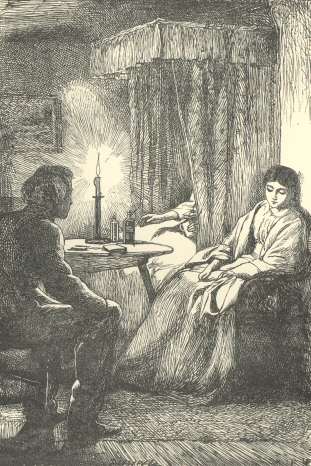
The wounds of which she had spoken, seemed to be about theneck of the self-made outcast. She dressed them now, stillwithout showing her. She steeped a piece of linen in abasin, into which she poured some liquid from a bottle, and laidit with a gentle hand upon the sore. The three-legged tablehad been drawn close to the bedside, and on it there were twobottles. This was one.
It was not so far off, but that Stephen, following her handswith his eyes, could read what was printed on it in largeletters. He turned of a deadly hue, and a sudden horrorseemed to fall upon him.
‘I will stay here, Stephen,’ said Rachael, quietlyresuming her seat, ‘till the bells go Three. ’Tis to be done again at three, and then she may be lefttill morning.’
‘But thy rest agen to-morrow’s work, mydear.’
‘I slept sound last night. I can wake many nights,when I am put to it. ’Tis thou who art in need ofrest—so white and tired. Try to sleep in the chairthere, while I watch. Thou hadst no sleep last night, I canwell believe. To-morrow’s work is far harder for theethan for me.’
He heard the thundering and surging out of doors, and itseemed to him as if his late angry mood were going about tryingto get at him. She had cast it out; she would keep it out;he trusted to her to defend him from himself.
‘She don’t know me, Stephen; she just drowsilymutters and stares. I have spoken to her times and again,but she don’t notice! ’Tis as well so. When she comes to her right mind once more, I shall have donewhat I can, and she never the wiser.’
‘How long, Rachael, is ’t looked for, thatshe’ll be so?’
‘Doctor said she would haply come to her mindto-morrow.’
His eyes fell again on the bottle, and a tremble passed overhim, causing him to shiver in every limb. She thought hewas chilled with the wet. ‘No,’ he said,‘it was not that. He had had a fright.’
‘A fright?’
‘Ay, ay! coming in. When I were walking. When I were thinking. When I—’ It seizedhim again; and he stood up, holding by the mantel-shelf, as hepressed his dank cold hair down with a hand that shook as if itwere palsied.
‘Stephen!’
She was coming to him, but he stretched out his arm to stopher.
‘No! Don’t, please; don’t. Letme see thee setten by the bed. Let me see thee, a’ sogood, and so forgiving. Let me see thee as I see thee whenI coom in. I can never see thee better than so. Never, never, never!’
He had a violent fit of trembling, and then sunk into hischair. After a time he controlled himself, and, restingwith an elbow on one knee, and his head upon that hand, couldlook towards Rachael. Seen across the dim candle with hismoistened eyes, she looked as if she had a glory shining roundher head. He could have believed she had. He didbelieve it, as the noise without shook the window, rattled at thedoor below, and went about the house clamouring andlamenting.
‘When she gets better, Stephen, ’tis to be hopedshe’ll leave thee to thyself again, and do thee no morehurt. Anyways we will hope so now. And now I shallkeep silence, for I want thee to sleep.’
He closed his eyes, more to please her than to rest his wearyhead; but, by slow degrees as he listened to the great noise ofthe wind, he ceased to hear it, or it changed into the working ofhis loom, or even into the voices of the day (his own included)saying what had been really said. Even this imperfectconsciousness faded away at last, and he dreamed a long, troubleddream.
He thought that he, and some one on whom his heart had longbeen set—but she was not Rachael, and that surprised him,even in the midst of his imaginary happiness—stood in thechurch being married. While the ceremony was performing,and while he recognized among the witnesses some whom he knew tobe living, and many whom he knew to be dead, darkness came on,succeeded by the shining of a tremendous light. It brokefrom one line in the table of commandments at the altar, andilluminated the building with the words. They were soundedthrough the church, too, as if there were voices in the fieryletters. Upon this, the whole appearance before him andaround him changed, and nothing was left as it had been, buthimself and the clergyman. They stood in the daylightbefore a crowd so vast, that if all the people in the world couldhave been brought together into one space, they could not havelooked, he thought, more numerous; and they all abhorred him, andthere was not one pitying or friendly eye among the millions thatwere fastened on his face. He stood on a raised stage,under his own loom; and, looking up at the shape the loom took,and hearing the burial service distinctly read, he knew that hewas there to suffer death. In an instant what he stood onfell below him, and he was gone.
—Out of what mystery he came back to his usual life, andto places that he knew, he was unable to consider; but he wasback in those places by some means, and with this condemnationupon him, that he was never, in this world or the next, throughall the unimaginable ages of eternity, to look on Rachael’sface or hear her voice. Wandering to and fro, unceasingly,without hope, and in search of he knew not what (he only knewthat he was doomed to seek it), he was the subject of a nameless,horrible dread, a mortal fear of one particular shape whicheverything took. Whatsoever he looked at, grew into thatform sooner or later. The object of his miserable existencewas to prevent its recognition by any one among the variouspeople he encountered. Hopeless labour! If he ledthem out of rooms where it was, if he shut up drawers and closetswhere it stood, if he drew the curious from places where he knewit to be secreted, and got them out into the streets, the verychimneys of the mills assumed that shape, and round them was theprinted word.
The wind was blowing again, the rain was beating on thehouse-tops, and the larger spaces through which he had strayedcontracted to the four walls of his room. Saving that thefire had died out, it was as his eyes had closed upon it. Rachael seemed to have fallen into a doze, in the chair by thebed. She sat wrapped in her shawl, perfectly still. The table stood in the same place, close by the bedside, and onit, in its real proportions and appearance, was the shape sooften repeated.
He thought he saw the curtain move. He looked again, andhe was sure it moved. He saw a hand come forth and gropeabout a little. Then the curtain moved more perceptibly,and the woman in the bed put it back, and sat up.
With her woful eyes, so haggard and wild, so heavy and large,she looked all round the room, and passed the corner where heslept in his chair. Her eyes returned to that corner, andshe put her hand over them as a shade, while she looked intoit. Again they went all round the room, scarcely heedingRachael if at all, and returned to that corner. He thought,as she once more shaded them—not so much looking at him, aslooking for him with a brutish instinct that he wasthere—that no single trace was left in those debauchedfeatures, or in the mind that went along with them, of the womanhe had married eighteen years before. But that he had seenher come to this by inches, he never could have believed her tobe the same.
All this time, as if a spell were on him, he was motionlessand powerless, except to watch her.
Stupidly dozing, or communing with her incapable self aboutnothing, she sat for a little while with her hands at her ears,and her head resting on them. Presently, she resumed herstaring round the room. And now, for the first time, hereyes stopped at the table with the bottles on it.
Straightway she turned her eyes back to his corner, with thedefiance of last night, and moving very cautiously and softly,stretched out her greedy hand. She drew a mug into the bed,and sat for a while considering which of the two bottles sheshould choose. Finally, she laid her insensate grasp uponthe bottle that had swift and certain death in it, and, beforehis eyes, pulled out the cork with her teeth.
Dream or reality, he had no voice, nor had he power tostir. If this be real, and her allotted time be not yetcome, wake, Rachael, wake!
She thought of that, too. She looked at Rachael, andvery slowly, very cautiously, poured out the contents. Thedraught was at her lips. A moment and she would be past allhelp, let the whole world wake and come about her with its utmostpower. But in that moment Rachael started up with asuppressed cry. The creature struggled, struck her, seizedher by the hair; but Rachael had the cup.
Stephen broke out of his chair. ‘Rachael, am Iwakin’ or dreamin’ this dreadfo’night?’
‘’Tis all well, Stephen. I have been asleep,myself. ’Tis near three. Hush! I hear thebells.’
The wind brought the sounds of the church clock to thewindow. They listened, and it struck three. Stephenlooked at her, saw how pale she was, noted the disorder of herhair, and the red marks of fingers on her forehead, and feltassured that his senses of sight and hearing had beenawake. She held the cup in her hand even now.
‘I thought it must be near three,’ she said,calmly pouring from the cup into the basin, and steeping thelinen as before. ‘I am thankful I stayed! ’Tis done now, when I have put this on. There! And now she’s quiet again. The few drops in the basinI’ll pour away, for ’tis bad stuff to leave about,though ever so little of it.’ As she spoke, shedrained the basin into the ashes of the fire, and broke thebottle on the hearth.
She had nothing to do, then, but to cover herself with hershawl before going out into the wind and rain.
‘Thou’lt let me walk wi’ thee at this hour,Rachael?’
‘No, Stephen. ’Tis but a minute, andI’m home.’
‘Thou’rt not fearfo’;’ he said it in alow voice, as they went out at the door; ‘to leave me alonewi’ her!’
As she looked at him, saying, ‘Stephen?’ he wentdown on his knee before her, on the poor mean stairs, and put anend of her shawl to his lips.
‘Thou art an Angel. Bless thee, blessthee!’
‘I am, as I have told thee, Stephen, thy poorfriend. Angels are not like me. Between them, and aworking woman fu’ of faults, there is a deep gulfset. My little sister is among them, but she ischanged.’
She raised her eyes for a moment as she said the words; andthen they fell again, in all their gentleness and mildness, onhis face.
‘Thou changest me from bad to good. Thoumak’st me humbly wishfo’ to be more like thee, andfearfo’ to lose thee when this life is ower, and a’the muddle cleared awa’. Thou’rt an Angel; itmay be, thou hast saved my soul alive!’
She looked at him, on his knee at her feet, with her shawlstill in p.69his hand, and the reproof on her lips died away when shesaw the working of his face.
‘I coom home desp’rate. I coom homewi’out a hope, and mad wi’ thinking that when I saida word o’ complaint I was reckoned a unreasonableHand. I told thee I had had a fright. It were thePoison-bottle on table. I never hurt a livin’creetur; but happenin’ so suddenly upon ’t, I thowt,“How can Isay what I might ha’ done tomyseln, or her, or both!”’
She put her two hands on his mouth, with a face of terror, tostop him from saying more. He caught them in his unoccupiedhand, and holding them, and still clasping the border of hershawl, said hurriedly:
‘But I see thee, Rachael, setten by the bed. Iha’ seen thee, aw this night. In my troublous sleep Iha’ known thee still to be there. Evermore I will seethee there. I nevermore will see her or think o’ her,but thou shalt be beside her. I nevermore will see or thinko’ anything that angers me, but thou, so much better thanme, shalt be by th’ side on’t. And so I willtry t’ look t’ th’ time, and so I will tryt’ trust t’ th’ time, when thou and me at lastshall walk together far awa’, beyond the deep gulf, inth’ country where thy little sister is.’
He kissed the border of her shawl again, and let her go. She bade him good night in a broken voice, and went out into thestreet.
The wind blew from the quarter where the day would soonappear, and still blew strongly. It had cleared the skybefore it, and the rain had spent itself or travelled elsewhere,and the stars were bright. He stood bare-headed in theroad, watching her quick disappearance. As the shiningstars were to the heavy candle in the window, so was Rachael, inthe rugged fancy of this man, to the common experiences of hislife.
CHAPTER XIV
THE GREAT MANUFACTURER
Time went on in Coketown like itsown machinery: so much material wrought up, so much fuelconsumed, so many powers worn out, so much money made. But,less inexorable than iron, steel, and brass, it brought itsvarying seasons even into that wilderness of smoke and brick, andmade the only stand that ever wasmade in the placeagainst its direful uniformity.
‘Louisa is becoming,’ said Mr. Gradgrind,‘almost a young woman.’
Time, with his innumerable horse-power, worked away, notminding what anybody said, and presently turned out young Thomasa foot taller than when his father had last taken particularnotice of him.
‘Thomas is becoming,’ said Mr. Gradgrind,‘almost a young man.’
Time passed Thomas on in the mill, while his father wasthinking about it, and there he stood in a long-tailed coat and astiff shirt-collar.
‘Really,’ said Mr. Gradgrind, ‘the periodhas arrived when Thomas ought to go to Bounderby.’
Time, sticking to him, passed him on into Bounderby’sBank, made him an inmate of Bounderby’s house, necessitatedthe purchase of his first razor, and exercised him diligently inhis calculations relative to number one.
The same great manufacturer, always with an immense variety ofwork on hand, in every stage of development, passed Sissy onwardin his mill, and worked her up into a very pretty articleindeed.
‘I fear, Jupe,’ said Mr. Gradgrind, ‘thatyour continuance at the school any longer would beuseless.’
‘I am afraid it would, sir,’ Sissy answered with acurtsey.
‘I cannot disguise from you, Jupe,’ said Mr.Gradgrind, knitting his brow, ‘that the result of yourprobation there has disappointed me; has greatly disappointedme. You have not acquired, under Mr. and Mrs.M’Choakumchild, anything like that amount of exactknowledge which I looked for. You are extremely deficientin your facts. Your acquaintance with figures is verylimited. You are altogether backward, and below themark.’
‘I am sorry, sir,’ she returned; ‘but I knowit is quite true. Yet I have tried hard, sir.’
‘Yes,’ said Mr. Gradgrind, ‘yes, I believeyou have tried hard; I have observed you, and I can find no faultin that respect.’
‘Thank you, sir. I have thought sometimes;’Sissy very timid here; ‘that perhaps I tried to learn toomuch, and that if I had asked to be allowed to try a little less,I might have—’
‘No, Jupe, no,’ said Mr. Gradgrind, shaking hishead in his profoundest and most eminently practical way. ‘No. The course you pursued, you pursued according tothe system—the system—and there is no more to be saidabout it. I can only suppose that the circumstances of yourearly life were too unfavourable to the development of yourreasoning powers, and that we began too late. Still, as Ihave said already, I am disappointed.’
‘I wish I could have made a better acknowledgment, sir,of your kindness to a poor forlorn girl who had no claim uponyou, and of your protection of her.’
‘Don’t shed tears,’ said Mr.Gradgrind. ‘Don’t shed tears. Idon’t complain of you. You are an affectionate,earnest, good young woman—and—and we must make thatdo.’
‘Thank you, sir, very much,’ said Sissy, with agrateful curtsey.
‘You are useful to Mrs. Gradgrind, and (in a generallypervading way) you are serviceable in the family also; so Iunderstand from Miss Louisa, and, indeed, so I have observedmyself. I therefore hope,’ said Mr. Gradgrind,‘that you can make yourself happy in thoserelations.’
‘I should have nothing to wish, sir,if—’
‘I understand you,’ said Mr. Gradgrind; ‘youstill refer to your father. I have heard from Miss Louisathat you still preserve that bottle. Well! If yourtraining in the science of arriving at exact results had beenmore successful, you would have been wiser on these points. I will say no more.’
He really liked Sissy too well to have a contempt for her;otherwise he held her calculating powers in such very slightestimation that he must have fallen upon that conclusion. Somehow or other, he had become possessed by an idea that therewas something in this girl which could hardly be set forth in atabular form. Her capacity of definition might be easilystated at a very low figure, her mathematical knowledge atnothing; yet he was not sure that if he had been required, forexample, to tick her off into columns in a parliamentary return,he would have quite known how to divide her.
In some stages of his manufacture of the human fabric, theprocesses of Time are very rapid. Young Thomas and Sissybeing both at such a stage of their working up, these changeswere effected in a year or two; while Mr. Gradgrind himselfseemed stationary in his course, and underwent no alteration.
Except one, which was apart from his necessary progressthrough the mill. Time hustled him into a little noisy andrather dirty machinery, in a by-comer, and made him Member ofParliament for Coketown: one of the respected members for ounceweights and measures, one of the representatives of themultiplication table, one of the deaf honourable gentlemen, dumbhonourable gentlemen, blind honourable gentlemen, lame honourablegentlemen, dead honourable gentlemen, to every otherconsideration. Else wherefore live we in a Christian land,eighteen hundred and odd years after our Master?
All this while, Louisa had been passing on, so quiet andreserved, and so much given to watching the bright ashes attwilight as they fell into the grate, and became extinct, thatfrom the period when her father had said she was almost a youngwoman—which seemed but yesterday—she had scarcelyattracted his notice again, when he found her quite a youngwoman.
‘Quite a young woman,’ said Mr. Gradgrind,musing. ‘Dear me!’
Soon after this discovery, he became more thoughtful thanusual for several days, and seemed much engrossed by onesubject. On a certain night, when he was going out, andLouisa came to bid him good-bye before his departure—as hewas not to be home until late and she would not see him againuntil the morning—he held her in his arms, looking at herin his kindest manner, and said:
‘My dear Louisa, you are a woman!’
She answered with the old, quick, searching look of the nightwhen she was found at the Circus; then cast down her eyes. ‘Yes, father.’
‘My dear,’ said Mr. Gradgrind, ‘I must speakwith you alone and seriously. Come to me in my room afterbreakfast to-morrow, will you?’
‘Yes, father.’
‘Your hands are rather cold, Louisa. Are you notwell?’
‘Quite well, father.’
‘And cheerful?’
She looked at him again, and smiled in her peculiarmanner. ‘I am as cheerful, father, as I usually am,or usually have been.’
‘That’s well,’ said Mr. Gradgrind. So,he kissed her and went away; and Louisa returned to the sereneapartment of the hair-cutting character, and leaning her elbow onher hand, looked again at the short-lived sparks that so soonsubsided into ashes.
‘Are you there, Loo?’ said her brother, looking inat the door. He was quite a young gentleman of pleasurenow, and not quite a prepossessing one.
‘Dear Tom,’ she answered, rising and embracinghim, ‘how long it is since you have been to seeme!’
‘Why, I have been otherwise engaged, Loo, in theevenings; and in the daytime old Bounderby has been keeping me atit rather. But I touch him up with you when he comes it toostrong, and so we preserve an understanding. I say! Has father said anything particular to you to-day or yesterday,Loo?’
‘No, Tom. But he told me to-night that he wishedto do so in the morning.’
‘Ah! That’s what I mean,’ saidTom. ‘Do you know where he isto-night?’—with a very deep expression.
‘No.’
‘Then I’ll tell you. He’s with oldBounderby. They are having a regular confab together up atthe Bank. Why at the Bank, do you think? Well,I’ll tell you again. To keep Mrs. Sparsit’sears as far off as possible, I expect.’
With her hand upon her brother’s shoulder, Louisa stillstood looking at the fire. Her brother glanced at her facewith greater interest than usual, and, encircling her waist withhis arm, drew her coaxingly to him.
p.73‘You are very fond of me, an’t you,Loo?’
‘Indeed I am, Tom, though you do let such long intervalsgo by without coming to see me.’
‘Well, sister of mine,’ said Tom, ‘when yousay that, you are near my thoughts. We might be so muchoftener together—mightn’t we? Always together,almost—mightn’t we? It would do me a great dealof good if you were to make up your mind to I know what,Loo. It would be a splendid thing for me. It would beuncommonly jolly!’
Her thoughtfulness baffled his cunning scrutiny. Hecould make nothing of her face. He pressed her in his arm,and kissed her cheek. She returned the kiss, but stilllooked at the fire.
‘I say, Loo! I thought I’d come, and justhint to you what was going on: though I supposed you’d mostlikely guess, even if you didn’t know. I can’tstay, because I’m engaged to some fellows to-night. You won’t forget how fond you are of me?’
‘No, dear Tom, I won’t forget.’
‘That’s a capital girl,’ said Tom. ‘Good-bye, Loo.’
She gave him an affectionate good-night, and went out with himto the door, whence the fires of Coketown could be seen, makingthe distance lurid. She stood there, looking steadfastlytowards them, and listening to his departing steps. Theyretreated quickly, as glad to get away from Stone Lodge; and shestood there yet, when he was gone and all was quiet. Itseemed as if, first in her own fire within the house, and then inthe fiery haze without, she tried to discover what kind of woofOld Time, that greatest and longest-established Spinner of all,would weave from the threads he had already spun into awoman. But his factory is a secret place, his work isnoiseless, and his Hands are mutes.
CHAPTER XV
FATHER AND DAUGHTER
Although Mr. Gradgrind did not takeafter Blue Beard, his room was quite a blue chamber in itsabundance of blue books. Whatever they could prove (whichis usually anything you like), they proved there, in an armyconstantly strengthening by the arrival of new recruits. Inthat charmed apartment, the most complicated social questionswere cast up, got into exact totals, and finally settled—ifthose concerned could only have been brought to know it. Asif an astronomical observatory should be made without anywindows, and the astronomer within should arrange the starryuniverse solely by pen, ink, and paper, so Mr. Gradgrind, inhisObservatory (and there are many like it), had no needto cast an eye upon the teeming myriads of human beings aroundhim, but could settle all their destinies on a slate, and wipeout all their tears with one dirty little bit of sponge.
To this Observatory, then: a stern room, with a deadlystatistical clock in it, which measured every second with a beatlike a rap upon a coffin-lid; Louisa repaired on the appointedmorning. A window looked towards Coketown; and when she satdown near her father’s table, she saw the high chimneys andthe long tracts of smoke looming in the heavy distancegloomily.
‘My dear Louisa,’ said her father, ‘Iprepared you last night to give me your serious attention in theconversation we are now going to have together. You havebeen so well trained, and you do, I am happy to say, so muchjustice to the education you have received, that I have perfectconfidence in your good sense. You are not impulsive, youare not romantic, you are accustomed to view everything from thestrong dispassionate ground of reason and calculation. Fromthat ground alone, I know you will view and consider what I amgoing to communicate.’
He waited, as if he would have been glad that she saidsomething. But she said never a word.
‘Louisa, my dear, you are the subject of a proposal ofmarriage that has been made to me.’
Again he waited, and again she answered not one word. This so far surprised him, as to induce him gently to repeat,‘a proposal of marriage, my dear.’ To which shereturned, without any visible emotion whatever:
‘I hear you, father. I am attending, I assureyou.’
‘Well!’ said Mr. Gradgrind, breaking into a smile,after being for the moment at a loss, ‘you are even moredispassionate than I expected, Louisa. Or, perhaps, you arenot unprepared for the announcement I have it in charge tomake?’
‘I cannot say that, father, until I hear it. Prepared or unprepared, I wish to hear it all from you. Iwish to hear you state it to me, father.’
Strange to relate, Mr. Gradgrind was not so collected at thismoment as his daughter was. He took a paper-knife in hishand, turned it over, laid it down, took it up again, and eventhen had to look along the blade of it, considering how to goon.
‘What you say, my dear Louisa, is perfectlyreasonable. I have undertaken then to let you knowthat—in short, that Mr. Bounderby has informed me that hehas long watched your progress with particular interest andpleasure, and has long hoped that the time might ultimatelyarrive when he should offer you his hand in marriage. Thattime, to which he has so long, and certainly with greatconstancy, looked forward, is now come. Mr. Bounderby hasmade his proposal of marriage to me, and has entreated me to makeit known to you, and to express his hope that you will take itinto your favourable consideration.’
Silence between them. The deadly statistical clock veryhollow. The distant smoke very black and heavy.
‘Father,’ said Louisa, ‘do you think I loveMr. Bounderby?’
Mr. Gradgrind was extremely discomfited by this unexpectedquestion. ‘Well, my child,’ he returned,‘I—really—cannot take upon myself tosay.’
‘Father,’ pursued Louisa in exactly the same voiceas before, ‘do you ask me to love Mr. Bounderby?’
‘My dear Louisa, no. No. I asknothing.’
‘Father,’ she still pursued, ‘does Mr.Bounderby ask me to love him?’
‘Really, my dear,’ said Mr. Gradgrind, ‘itis difficult to answer your question—’
‘Difficult to answer it, Yes or No, father?
‘Certainly, my dear. Because;’ here wassomething to demonstrate, and it set him up again; ‘becausethe reply depends so materially, Louisa, on the sense in which weuse the expression. Now, Mr. Bounderby does not do you theinjustice, and does not do himself the injustice, of pretendingto anything fanciful, fantastic, or (I am using synonymous terms)sentimental. Mr. Bounderby would have seen you grow upunder his eyes, to very little purpose, if he could so far forgetwhat is due to your good sense, not to say to his, as to addressyou from any such ground. Therefore, perhaps the expressionitself—I merely suggest this to you, my dear—may be alittle misplaced.’
‘What would you advise me to use in its stead,father?’
‘Why, my dear Louisa,’ said Mr. Gradgrind,completely recovered by this time, ‘I would advise you(since you ask me) to consider this question, as you have beenaccustomed to consider every other question, simply as one oftangible Fact. The ignorant and the giddy may embarrasssuch subjects with irrelevant fancies, and other absurdities thathave no existence, properly viewed—really noexistence—but it is no compliment to you to say, that youknow better. Now, what are the Facts of this case? You are, we will say in round numbers, twenty years of age; Mr.Bounderby is, we will say in round numbers, fifty. There issome disparity in your respective years, but in your means andpositions there is none; on the contrary, there is a greatsuitability. Then the question arises, Is this onedisparity sufficient to operate as a bar to such amarriage? In considering this question, it is notunimportant to take into account the statistics of marriage, sofar as they have yet been obtained, in England and Wales. Ifind, on reference to the figures, that a large proportion ofthese marriages are contracted between parties of very unequalages, and that the elder of these contracting parties is, inrather more than three-fourths of these instances, thebridegroom. It is remarkable as showing the wide prevalenceof this law, that among the natives of the British possessions inIndia, also in a considerable part of China, and among theCalmucks of Tartary, the best means of computation yet furnishedus by travellers, yield similar results. The disparity Ihave mentioned, therefore, almost ceases to be disparity, and(virtually) all but disappears.’
‘What do you recommend, father,’ asked Louisa, herreserved composure not in the least affected by these gratifyingresults, ‘that I should substitute for the term I used justnow? For the misplaced expression?’
‘Louisa,’ returned her father, ‘it appearsto me that nothing can be plainer. Confining yourselfrigidly to Fact, the question of Fact you state to yourself is:Does Mr. Bounderby ask me to marry him? Yes, he does. The sole remaining question then is: Shall I marry him? Ithink nothing can be plainer than that?’
‘Shall I marry him?’ repeated Louisa, with greatdeliberation.
‘Precisely. And it is satisfactory to me, as yourfather, my dear Louisa, to know that you do not come to theconsideration of that question with the previous habits of mind,and habits of life, that belong to many young women.’
‘No, father,’ she returned, ‘I donot.’
‘I now leave you to judge for yourself,’ said Mr.Gradgrind. ‘I have stated the case, as such cases areusually stated among practical minds; I have stated it, as thecase of your mother and myself was stated in its time. Therest, my dear Louisa, is for you to decide.’
From the beginning, she had sat looking at him fixedly. As he now leaned back in his chair, and bent his deep-set eyesupon her in his turn, perhaps he might have seen one waveringmoment in her, when she was impelled to throw herself upon hisbreast, and give him the pent-up confidences of her heart. But, to see it, he must have overleaped at a bound the artificialbarriers he had for many years been erecting, between himself andall those subtle essences of humanity which will elude the utmostcunning of algebra until the last trumpet ever to be soundedshall blow even algebra to wreck. The barriers were toomany and too high for such a leap. With his unbending,utilitarian, matter-of-fact face, he hardened her again; and themoment shot away into the plumbless depths of the past, to minglewith all the lost opportunities that are drowned there.
Removing her eyes from him, she sat so long looking silentlytowards the town, that he said, at length: ‘Are youconsulting the chimneys of the Coketown works, Louisa?’
‘There seems to be nothing there but languid andmonotonous smoke. Yet when the night comes, Fire burstsout, father!’ she answered, turning quickly.
‘Of course I know that, Louisa. I do not see theapplication of the remark.’ To do him justice he didnot, at all.
She passed it away with a slight motion of her hand, andconcentrating her attention upon him again, said, ‘Father,I have often thought that life is very short.’—Thiswas so distinctly one of his subjects that he interposed.
‘It is short, no doubt, my dear. Still, theaverage duration of human life is proved to have increased oflate years. The calculations of various life assurance andannuity offices, among other figures which cannot go wrong, haveestablished the fact.’
‘I speak of my own life, father.’
‘O indeed? Still,’ said Mr. Gradgrind,‘I need not point out to you, Louisa, that it is governedby the laws which govern lives in the aggregate.’
‘While it lasts, I would wish to do the little I can,and the little I am fit for. What does itmatter?’
Mr. Gradgrind seemed rather at a loss to understand the lastfour words; replying, ‘How, matter? What matter, mydear?’
‘Mr. Bounderby,’ she went on in a steady, straightway, without regarding this, ‘asks me to marry him. The question I have to ask myself is, shall I marry him? That is so, father, is it not? You have told me so,father. Have you not?’
‘Certainly, my dear.’
‘Let it be so. Since Mr. Bounderby likes to takeme thus, I am satisfied to accept his proposal. Tell him,father, as soon as you please, that this was my answer. Repeat it, word for word, if you can, because I should wish himto know what I said.’
‘It is quite right, my dear,’ retorted her fatherapprovingly, ‘to be exact. I will observe your veryproper request. Have you any wish in reference to theperiod of your marriage, my child?’
‘None, father. What does it matter!’
Mr. Gradgrind had drawn his chair a little nearer to her, andtaken her hand. But, her repetition of these words seemedto strike with some little discord on his ear. He paused tolook at her, and, still holding her hand, said:
‘Louisa, I have not considered it essential to ask youone question, because the possibility implied in it appeared tome to be too remote. But perhaps I ought to do so. You have never entertained in secret any otherproposal?’
‘Father,’ she returned, almost scornfully,‘what other proposal can have been made to me? Whom have I seen? Where have I been? What are myheart’s experiences?’
‘My dear Louisa,’ returned Mr. Gradgrind,reassured and satisfied. ‘You correct mejustly. I merely wished to discharge my duty.’
‘What do Iknow, father,’ said Louisa inher quiet manner, ‘of tastes and fancies; of aspirationsand affections; of all that part of my nature in which such lightthings might have been nourished? What escape have I hadfrom problems that could be demonstrated, and realities thatcould be grasped?’ As she said it, she unconsciouslyclosed her hand, as if upon a solid object, and slowly opened itas though she were releasing dust or ash.
‘My dear,’ assented her eminently practicalparent, ‘quite true, quite true.’
‘Why, father,’ she pursued, ‘what a strangequestion to ask me! The baby-preference that even Ihave heard of as common among children, has never had itsinnocent resting-place in my breast. You have been socareful of me, that I never had a child’s heart. Youhave trained me so well, that I never dreamed a child’sdream. You have dealt so wisely with me, father, from mycradle to this hour, that I never had a child’s belief or achild’s fear.’
Mr. Gradgrind was quite moved by his success, and by thistestimony to it. ‘My dear Louisa,’ said he,‘you abundantly repay my care. Kiss me, my deargirl.’
So, his daughter kissed him. Detaining her in hisembrace, he said, ‘I may assure you now, my favouritechild, that I am made happy by the sound decision at which youhave arrived. Mr. Bounderby is a very remarkable man; andwhat little disparity can be said to exist between you—ifany—is more than counterbalanced by the tone your mind hasacquired. It has always been my object so to educate you,as that you might, while still in your early youth, be (if I mayso express myself) almost any age. Kiss me once more,Louisa. Now, let us go and find your mother.’
Accordingly, they went down to the drawing-room, where theesteemed lady with no nonsense about her, was recumbent as usual,while Sissy worked beside her. She gave some feeble signsof returning animation when they entered, and presently the fainttransparency was presented in a sitting attitude.
‘Mrs. Gradgrind,’ said her husband, who had waitedfor the achievement of this feat with some impatience,‘allow me to present to you Mrs. Bounderby.’
‘Oh!’ said Mrs. Gradgrind, ‘so you havesettled it! Well, I’m sure I hope your health may begood, Louisa; for if your head b